Note: you have to register to view The Lancet but registration is free and the articles mentioned here are not restricted.
There was a letter in the Lancet this week, which starts off saying "Sadly, The Lancet is still part of the plot" in response to an earlier article "The Health of Women".
The earlier article, published for International Women's Day, states "no country in the world can women claim to have the same rights and opportunities as men. This is especially so in the context of health", giving as an example sexual and reproductive health accounting for a third of lost life-years in women of reproductive age.
The letter writer claims that yes, there is sexual inequality, but that the problem is men's health and not women's. He bases his argument on articles which discuss the UK and Australia, totally ignoring the situation in the developing world.
I really hope someone with a better understanding of the issues will reply.
Monday, 30 April 2007

A proud mother
I'm sorry about this. Please look away if you can't stomach it ...
I must have done something right somewhere along the way when I brought up my son: he and his fiancée have asked for no wedding presents, just donations to a charity providing medical treatment for children in Africa.
A chip off the old block, or brainwashing.
I must have done something right somewhere along the way when I brought up my son: he and his fiancée have asked for no wedding presents, just donations to a charity providing medical treatment for children in Africa.
A chip off the old block, or brainwashing.
Fear and Trembling by Amélie Nothomb

I’m not quite sure when I became aware of Amélie Nothomb. I’ve noticed her books for sale for several years, and I knew they weren’t new because they are readily available in French supermarkets, but why I should have noticed them above others, I don’t know.
Fear and Trembling, as many if not all of her books, is at least semi-autobiographical so as much as anything, I learnt about the author, and it rapidly became obvious that she is Belgian and not French. She was born in Japan to a family in the diplomatic service and lived there until she was five. She speaks fluent Japanese and did return to work in a Japanese company for a year.
Although for some reason I thought it was going to be a “difficult” book, it wasn’t at all: it’s entertaining and very easy to read. My usual caution about reading books in translation was totally swept away because at no point was I aware of its having been originally in French.
I don’t know whether the fairly dreadful portrayal of Japanese corporate life is accurate or not, but the most fascinating part of the book I found was the section about Japanese women, “if the Japanese woman is to be admired – and she is – it is because she doesn’t commit suicide”. Japan apparently has one of the highest suicide rates in the world, but in spite of the pressures put on them by society, the rate is very much lower in women than men. How much that holds true now I’m not sure.
Something I heard quite a while ago was also mentioned in the book. When people were starting to become aware of water conservation, a hotel said it would be very difficult to put effective measures in to reduce water consumption because a large portion of their clientele was Japanese. Apparently Japanese women become terminally embarrassed if they feel they can be overheard in the bathroom and will turn taps on full in order to prevent this. I never really knew if this was true, but Amélie Nothomb says the same thing.
Fear and Trembling, as many if not all of her books, is at least semi-autobiographical so as much as anything, I learnt about the author, and it rapidly became obvious that she is Belgian and not French. She was born in Japan to a family in the diplomatic service and lived there until she was five. She speaks fluent Japanese and did return to work in a Japanese company for a year.
Although for some reason I thought it was going to be a “difficult” book, it wasn’t at all: it’s entertaining and very easy to read. My usual caution about reading books in translation was totally swept away because at no point was I aware of its having been originally in French.
I don’t know whether the fairly dreadful portrayal of Japanese corporate life is accurate or not, but the most fascinating part of the book I found was the section about Japanese women, “if the Japanese woman is to be admired – and she is – it is because she doesn’t commit suicide”. Japan apparently has one of the highest suicide rates in the world, but in spite of the pressures put on them by society, the rate is very much lower in women than men. How much that holds true now I’m not sure.
Something I heard quite a while ago was also mentioned in the book. When people were starting to become aware of water conservation, a hotel said it would be very difficult to put effective measures in to reduce water consumption because a large portion of their clientele was Japanese. Apparently Japanese women become terminally embarrassed if they feel they can be overheard in the bathroom and will turn taps on full in order to prevent this. I never really knew if this was true, but Amélie Nothomb says the same thing.
I’d be happy to read any more of her books and I may even try one in French. I gather it was made into a film and released in 2004, so I must try to find it on DVD. According to the reports I’ve read, it is equally good.
Saturday, 28 April 2007
The office cleaner
When I’m in the UK I work in a proper office, not from home. I often work late. I feel I need to give them, the powers that be, their money’s worth in exchange for allowing me to work from home, when home happens to be France.
Because I work late I frequently see the cleaners. This trip back there has been a new cleaner, new to me anyway. He is an exceptionally pleasant man, I’d say in his 40s, and we always exchange a few words, have a short conversation about this or that.
Yesterday I apologised for having used two bins where one would have done. He replied that it was his job after all, and then added that it wouldn’t be for much longer.
It turns out that he is an aeronautical engineering lecturer at home. He’s in the UK with his wife who is just about to finish her PhD, and then they’ll return. He has found it difficult just filling in time, a three year holiday, something I can sympathise with after the three years we spent in Paris.
I find the story remarkable in several ways: first that he’s prepared to give up three years of seniority in his career to further his wife’s; second that his employer can let him have three years’ unpaid leave even though I know it’s easier in academic circles; and third that he’s prepared to take on a cleaning job for something to do.
Because I work late I frequently see the cleaners. This trip back there has been a new cleaner, new to me anyway. He is an exceptionally pleasant man, I’d say in his 40s, and we always exchange a few words, have a short conversation about this or that.
Yesterday I apologised for having used two bins where one would have done. He replied that it was his job after all, and then added that it wouldn’t be for much longer.
It turns out that he is an aeronautical engineering lecturer at home. He’s in the UK with his wife who is just about to finish her PhD, and then they’ll return. He has found it difficult just filling in time, a three year holiday, something I can sympathise with after the three years we spent in Paris.
I find the story remarkable in several ways: first that he’s prepared to give up three years of seniority in his career to further his wife’s; second that his employer can let him have three years’ unpaid leave even though I know it’s easier in academic circles; and third that he’s prepared to take on a cleaning job for something to do.
PhotoHunter: Rare

This is a pen and ink drawing of a Citroen 2CV6 (or deux chevaux), close-up below. I drove 2CVs for years, first a yellow one and then a red and grey one very like this. I had to get a "proper" car in the end because my sons were growing up and the additional weight in the back made it slow down too much. Not the most powerful of cars, or the most comfortable, but great fun.

I chose this as my offering for Rare, because they ceased production on 27 July 1990, so they are becoming more rare all the time.
I hasten to add that I did not do the drawing, it was Sonia Bignall, whose signature can just about be seen
Friday, 27 April 2007
Some better news from Malawi
Two reports from IRIN (Integrated Regional Information Networks - part of the UN Office for the Coordination of Humanitarian Affairs) and both have better news for Malawi
The first tells of a record maize harvest this year, which appears to be the result of the government subsidising the price of fertilizer by about 75%. This subsidy helps enormously except of course for the very poorest subsistence farmers. There are calls to provide fee fertilizer for this group, who often are looking after orphans as well as their own families. And no matter what the subsidy, lack of rain has caused a failing harvest in the Karonga district. There they need irrigation equipment.
The second report is about progress of fish farming in the southern countries of Africa which could be a good source of income and food. However most initiatives are hampered by lack of funds, skills and equipment. According to the UN Food and Agricultural Organisation, nearly half the fish eaten worldwide is farmed. As stocks of wild fish decline, there will be greater and greater demand for farmed fish.
The first tells of a record maize harvest this year, which appears to be the result of the government subsidising the price of fertilizer by about 75%. This subsidy helps enormously except of course for the very poorest subsistence farmers. There are calls to provide fee fertilizer for this group, who often are looking after orphans as well as their own families. And no matter what the subsidy, lack of rain has caused a failing harvest in the Karonga district. There they need irrigation equipment.
The second report is about progress of fish farming in the southern countries of Africa which could be a good source of income and food. However most initiatives are hampered by lack of funds, skills and equipment. According to the UN Food and Agricultural Organisation, nearly half the fish eaten worldwide is farmed. As stocks of wild fish decline, there will be greater and greater demand for farmed fish.
Thursday, 26 April 2007
How Proust Can Change Your Life - Alain de Botton

Please remind me not to read any more non-fiction books, at least not random, spur of the moment, purchases.
I can read all sorts of fiction, some I can hardly remember and others leave an imprint which I'll remember for ever. But non-fiction leaves me with a feeling that I should be taking notes and fixing something in my memory. Too many years of text-books I suppose. Reading them without worrying whether they do or do not leave an impression doen't seem to be an option.
I had the same struggle with this one. I found it in an Oxfam shop (so at least it was in a good cause) and I'd been offered another Alain de Botton title by Amazon for some reason known only to Amazon, so it was obviously meant for me.
It's easy enough to read, taking a light-hearted but informative look at Marcel Proust's "A la Recherche du temps perdu". I know now that you shouldn't sleep with anyone on a first date, you should learn from your suffering, and be a good friend. Oh, and you shouldn't use clichés. But the very last chapter was "How to Put Books Down". I think it ought to have been the first.
I don't think I'll be trying to plough my way through "A la Recherche du temps perdu" in French or in English any time soon.
Late abortions
The University of Southampton has just published a study on the reasons behind late abortion. It seems that there are a number of different reasons, but one that is noticeable is that many did not realise they were pregnant for quite a while.
The reasons given for this were:
Coupled with this is the problem of finding doctors who are willing and able to perform abortions, which has been widely reported as I mentioned in an earlier post. It was also covered well by the NHS Blog Doctor in NHS Blog Doctor: Libby Purves joins the abortion debate from a doctor's point of view. This can only lead to still further delays and if the law is tightened there could be repercussions for many women.
If things continue as they are, we may yet need the services of the Dutch abortion ship as discussed on the f-word and The Times. This ship became headline news when it was blocked from entering Portuguese waters to collect women for abortions. There is some speculation that this led to the relaxing of Portuguese abortion laws. The ship effectively had its licence removed by the right-wing Dutch government in 2004 by banning it from sailing beyond a 15 mile radius of a Dutch hospital, but the government has now been replaced and the licence has been given back . It can perform abortions up to only 7 weeks of pregnancy but they are hoping to have this extended to 12 weeks.
The only EU country which no longer allows abortion is Malta, with Ireland and Poland having very strict conditions.
The reasons given for this were:
- Irregular periods
- Using contraception
- Continued having periods
Coupled with this is the problem of finding doctors who are willing and able to perform abortions, which has been widely reported as I mentioned in an earlier post. It was also covered well by the NHS Blog Doctor in NHS Blog Doctor: Libby Purves joins the abortion debate from a doctor's point of view. This can only lead to still further delays and if the law is tightened there could be repercussions for many women.
If things continue as they are, we may yet need the services of the Dutch abortion ship as discussed on the f-word and The Times. This ship became headline news when it was blocked from entering Portuguese waters to collect women for abortions. There is some speculation that this led to the relaxing of Portuguese abortion laws. The ship effectively had its licence removed by the right-wing Dutch government in 2004 by banning it from sailing beyond a 15 mile radius of a Dutch hospital, but the government has now been replaced and the licence has been given back . It can perform abortions up to only 7 weeks of pregnancy but they are hoping to have this extended to 12 weeks.
The only EU country which no longer allows abortion is Malta, with Ireland and Poland having very strict conditions.
Tuesday, 24 April 2007
Grand Rounds
Papillon's Remembering and Forgetting post is mentioned over on Med Valley High, in Grand Rounds, a collection of interesting pieces from the medical blogosphere. Her very latest post can always be reached from the side bar on the right, including the date of last update, as can her blog in the original French.
For anyone interested in medical subjects, Grand Rounds is a weekly round-up of posts that have caught the attention of that week's host.
For anyone interested in medical subjects, Grand Rounds is a weekly round-up of posts that have caught the attention of that week's host.
Saturday, 21 April 2007
Climate change affects us all
I have a bad habit of reading climate change reports and looking at how it will have an effect on my own life. But I live in a part of the world which could adapt: many don't.
ActionAid is an international agency fighting poverty in 42 countries worldwide. They have published a report that says climate change is being felt very acutely by some of the poorest communities. (The full report can be downloaded as a pdf file).
Of particular interest to me is the report, that in Malawi 90% of the 6.3 million living below the poverty line rely on subsistence farming to survive at all. They are already farming in fairly extreme conditions, so any changes in climate have considerable impact. They are themselves aware that their food production has decreased because of frequent flooding and drought.
ActionAid is an international agency fighting poverty in 42 countries worldwide. They have published a report that says climate change is being felt very acutely by some of the poorest communities. (The full report can be downloaded as a pdf file).
Of particular interest to me is the report, that in Malawi 90% of the 6.3 million living below the poverty line rely on subsistence farming to survive at all. They are already farming in fairly extreme conditions, so any changes in climate have considerable impact. They are themselves aware that their food production has decreased because of frequent flooding and drought.
- They no longer know when is the best time to plant. The rainy season used to start in October but during the 70s started moving to November and now starts in December. They therefore ought to be using a fast-maturing crop to allow for the shorter season but
privatisation of seed companies means that hybrids developed are too expensive for many. - The change in rainfall has caused an increase in certain diseases such as malaria, cholera and dysentry. It falls to the women to care for the sick, and this then prevents them working in the fields.
- The floods and droughts happen more often, leaving little time to recover and adapt.
- Deforestation is increasing and existing laws to control it are not being enforced.
- The decrease in livelihood is forcing more people to look for work elsewhere, which in turn is forcing women into unsafe sex, thus increasing the risk of HIV/AIDS.
A multi-national wedding
My son is going to be married in June (and that's a mystery - how did he get from being my baby to being married in, umm, about ten years?)
He is British, of Italian, Scottish and Irish descent. His fiancée is French of Algerian and Egyptian descent. Attending the wedding will be family from France, Scotland, Ireland, Italy, Algeria, Egypt, Canada, England, Monaco, Iran and the US. Friends could come from anywhere.
Not everyone speaks French or English.
It will be interesting.
He is British, of Italian, Scottish and Irish descent. His fiancée is French of Algerian and Egyptian descent. Attending the wedding will be family from France, Scotland, Ireland, Italy, Algeria, Egypt, Canada, England, Monaco, Iran and the US. Friends could come from anywhere.
Not everyone speaks French or English.
It will be interesting.
PhotoHunter: Steps

As I was walking down by the river yesterday, I noticed these steps leading from the house up above down to the waterside. Although it's on full view, it makes me think of a secret garden.
Thursday, 19 April 2007
Yoruba Girl Dancing by Simi Bedford
It isn’t quite the book I had expected, but I did enjoy it all the same. I understand it’s a partly autobiographical novel as Simi Bedford too was sent to boarding school in England at a very young age.
Remi, a Nigerian girl from Lagos, comes from a wealthy and educated family, with a large house and lots of servants. It is a lively household, with plenty of people coming and going. She is sent to boarding school in England at the unbelievably young age of six. What is even more amazing is that she is left in there for six years without once seeing her parents. In England, in total contrast to her home, she has to experience the loneliness of boarding school where it takes a while to become accepted by the other girls. These girls too come from privileged backgrounds but Remi spends the school holidays with the relatives of her step-grandmother, and they live in a much less affluent world.
She finds herself moving first from her familiar background in Lagos, and then between two different social classes in England, but an outsider in both. She learns to fit in with both settings by adapting her behaviour, in both cases involving fabricating stories about her life in Africa to fit in with her friends’ preconceived ideas, but she doesn’t lose her Nigerian identity completely. She encounters racism, but apparently a racism born of ignorance rather than outright hostility.
Although it is a book written with considerable humour, I found it a somewhat sad story. I can relate very much to the feeling of not quite fitting in anywhere. I’ve had a roaming life but I wouldn’t change it for the world. It’s given me a roaming mind and I’d prefer to have expanded horizons than static roots.
Remi, a Nigerian girl from Lagos, comes from a wealthy and educated family, with a large house and lots of servants. It is a lively household, with plenty of people coming and going. She is sent to boarding school in England at the unbelievably young age of six. What is even more amazing is that she is left in there for six years without once seeing her parents. In England, in total contrast to her home, she has to experience the loneliness of boarding school where it takes a while to become accepted by the other girls. These girls too come from privileged backgrounds but Remi spends the school holidays with the relatives of her step-grandmother, and they live in a much less affluent world.
She finds herself moving first from her familiar background in Lagos, and then between two different social classes in England, but an outsider in both. She learns to fit in with both settings by adapting her behaviour, in both cases involving fabricating stories about her life in Africa to fit in with her friends’ preconceived ideas, but she doesn’t lose her Nigerian identity completely. She encounters racism, but apparently a racism born of ignorance rather than outright hostility.
Although it is a book written with considerable humour, I found it a somewhat sad story. I can relate very much to the feeling of not quite fitting in anywhere. I’ve had a roaming life but I wouldn’t change it for the world. It’s given me a roaming mind and I’d prefer to have expanded horizons than static roots.
Simi Bedford has a new book to be published in July 2007, Not With Silver, about a warrior sold into slavery. It sounds worth reading.
Wednesday, 18 April 2007
Ne'er cast a clout till May is out
Alternatively, if you're French: En avril, ne te découvre pas d'un fil; en mai, fais ce qui te plaît.
I was thinking about this as I was driving to work this morning, seeing the students on their way into lectures wearing shorts, and wishing I hadn't left all my summer clothes in France.
Almost on cue, it said on the radio that the woodland Trust has declared that spring is the new summer because hawthorns (also known as May trees) are blossoming in the countryside and swifts are returning early, so if the BBC says so, it must be true.
I was thinking about this as I was driving to work this morning, seeing the students on their way into lectures wearing shorts, and wishing I hadn't left all my summer clothes in France.
Almost on cue, it said on the radio that the woodland Trust has declared that spring is the new summer because hawthorns (also known as May trees) are blossoming in the countryside and swifts are returning early, so if the BBC says so, it must be true.
Tuesday, 17 April 2007
Dr Pierre Foldès
The clitoris is now known to be much larger than the external glans, a relatively small structure which is removed during many forms of female genital mutilation or FGM, and so the possibility is there for reconstruction.
Dr Foldès is the surgeon in St Germain en Laye who is one of the few who perform clitoral reconstruction after FGM. There are plenty of others who perform repairs, or reversals, but do not rebuild the clitoris. Even reversal though, is a great step forward for women who have undergone more extreme forms of FGM. One report follows up some women who have had reversals done and found them very happy with the outcome.
As mentioned in one of Papillon’s posts, Dr Foldès has trained some Burkinabe surgeons in the techniques. There is an interview of one of them published online in January by the journalist Ochieng' Ogodo. He himself has now trained 50 surgeons in Burkina Faso to do the operation and is happy to pass on his expertise to surgeons in other African countries.
Christine Aziz has interviewed two women who have been patients of Dr Foldès, one French, originally from Somalia, and one Sudanese living in London. Their accounts are similar but well worth reading. A French journalist has written a book, Victoire sur l'excision, about this "modest and profoundly humanitarian doctor".
It is evident from all these stories that his patients have nothing but praise for the doctor.
Contact details for Dr Foldès:
Clinique St. Germain
12, rue Barone Gerard
78100 Saint Germain En Laye.

Dr Foldès is the surgeon in St Germain en Laye who is one of the few who perform clitoral reconstruction after FGM. There are plenty of others who perform repairs, or reversals, but do not rebuild the clitoris. Even reversal though, is a great step forward for women who have undergone more extreme forms of FGM. One report follows up some women who have had reversals done and found them very happy with the outcome.
As mentioned in one of Papillon’s posts, Dr Foldès has trained some Burkinabe surgeons in the techniques. There is an interview of one of them published online in January by the journalist Ochieng' Ogodo. He himself has now trained 50 surgeons in Burkina Faso to do the operation and is happy to pass on his expertise to surgeons in other African countries.
Christine Aziz has interviewed two women who have been patients of Dr Foldès, one French, originally from Somalia, and one Sudanese living in London. Their accounts are similar but well worth reading. A French journalist has written a book, Victoire sur l'excision, about this "modest and profoundly humanitarian doctor".
It is evident from all these stories that his patients have nothing but praise for the doctor.
Contact details for Dr Foldès:
Clinique St. Germain
12, rue Barone Gerard
78100 Saint Germain En Laye.
- tél : 0033 1 39 10 26 26
- tél : 0033 1 61 30 22 15
The World Bank
According to its website, the International Development Association (IDA) is the part of the World Bank that helps the world’s poorest countries. Established in 1960, IDA aims to reduce poverty by providing interest-free loans and grants for programs that boost economic growth, reduce inequalities and improve people’s living conditions.
It states that they are one of the world’s largest external funders in the fight against HIV/AIDS. Of the eight focus areas for Africa, one is health and another is women’s empowerment.
For a few days now there have been reports that references to family planning have been removed from their health strategy and from the Madagascar country assistance strategy. Without contraception, how are they going to achieve those aims?
Apparently Juan José Daboub, the Managing Director, has close ties with the Catholic church.
There are fuller reports in the Financial Times, the Guardian, and Guardian comment.
It states that they are one of the world’s largest external funders in the fight against HIV/AIDS. Of the eight focus areas for Africa, one is health and another is women’s empowerment.
For a few days now there have been reports that references to family planning have been removed from their health strategy and from the Madagascar country assistance strategy. Without contraception, how are they going to achieve those aims?
Apparently Juan José Daboub, the Managing Director, has close ties with the Catholic church.
There are fuller reports in the Financial Times, the Guardian, and Guardian comment.
Monday, 16 April 2007
Abortion crisis in the UK
The Royal College of Obstetricians and Gynaecologists today issued a statement to say that the number of doctors prepared to carry out abortions is gradually falling and will lead to a crisis in the service. They recognise any doctor's right to refuse to carry out abortions but equally are aware that it is an essential service. They go on to say that family planning and gynaecological services should have adequate funding to ensure that abortions are kept to a minimum.
There is an extensive and what seems to be a well-balanced report in the Independent. By the time the BBC reported the story, the situation was threatening the National Health Service.
The report I find interesting though, is also in the Independent, "Issue that goes to the heart of our differences with America". I've said in the past on other blogs that there just doesn't seem to be nearly as much emotion on this side of the Atlantic, but faced with the discussions that seem to abound, sometimes I have wondered if I was missing something here. A case of selective awareness perhaps, and only noticing opinions that would reinforce my own point of view. Well if that is the case, the Independent article is another reinforcement. I particularly like the final sentence.
There is an extensive and what seems to be a well-balanced report in the Independent. By the time the BBC reported the story, the situation was threatening the National Health Service.
The report I find interesting though, is also in the Independent, "Issue that goes to the heart of our differences with America". I've said in the past on other blogs that there just doesn't seem to be nearly as much emotion on this side of the Atlantic, but faced with the discussions that seem to abound, sometimes I have wondered if I was missing something here. A case of selective awareness perhaps, and only noticing opinions that would reinforce my own point of view. Well if that is the case, the Independent article is another reinforcement. I particularly like the final sentence.
Sunday, 15 April 2007
The future of abstinence?
From Alas, A Blog, via the f word, news that a study has been released showing that abstinence only campaigns have had no effect on sexual abstinence, unprotected sex, or the number of sexual partners.
This is on top of growing evidence that the Abstinence, Be faithful, use Condoms (ABC) campaign in Uganda has been failing because of a push towards abstinence and away from condom use which has gradually become more and more of an afterthought. Uganda used to be a success story in the fight against AIDS, but the infection rates are now rising. A comprehensive article appears in Thought Theater.
In Nyasa Times, from Malawi, there is an article saying that,as the result of AIDS, the army has been reduced by 40% which is a staggering amount. It also says that the US has tripled the amount of aid for fighting against HIV/AIDS. Now that this new report has been released, albeit very quietly, we can only hope that the aid programs will no longer tie money to abstinence programs.
According to Stephen Lewis, Special Envoy for HIV/AIDS in Africa, Western inertia is nailing the coffin shut for Africa.
This is on top of growing evidence that the Abstinence, Be faithful, use Condoms (ABC) campaign in Uganda has been failing because of a push towards abstinence and away from condom use which has gradually become more and more of an afterthought. Uganda used to be a success story in the fight against AIDS, but the infection rates are now rising. A comprehensive article appears in Thought Theater.
In Nyasa Times, from Malawi, there is an article saying that,as the result of AIDS, the army has been reduced by 40% which is a staggering amount. It also says that the US has tripled the amount of aid for fighting against HIV/AIDS. Now that this new report has been released, albeit very quietly, we can only hope that the aid programs will no longer tie money to abstinence programs.
According to Stephen Lewis, Special Envoy for HIV/AIDS in Africa, Western inertia is nailing the coffin shut for Africa.
Saturday, 14 April 2007
PhotoHunter: Hobby
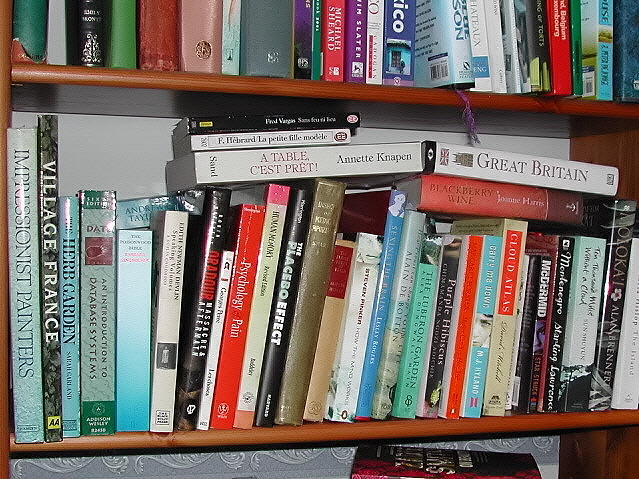
"I have always imagined that paradise will be a kind of library."
-Jorge Luis Borges
-Jorge Luis Borges
Just one section of one bookshelf, and some of the books which reflect my interests. Pride of place is given to the tall olive green book near the centre, which is "Insects of Medical Importance". I don't have a particular interest in insects but my father had it when he was a student at the Liverpool School of Tropical Medicine, and he gave it to me on the day I left home to become a student at Liverpool University.
"A room without books is like a body without a soul."
-GK Chesterton
Update on the need for molecular condom research
If you wonder why it might be needed, read this article in AllAfrica.com, Malawi: Condoms Get a Bad Rap.
Selected quotes:
The molecular condom would be a huge step forward in overcoming the problem, but it's just a pity that the lead time is so great. In the meantime, it must be down to education, education, education.
Selected quotes:
The least popular form of behaviour change reported by the study was the use of condoms.
despite surveys showing awareness of how HIV is contracted, condom use remains unpopular among Swazis
The conservative nation's top traditional leader, Jim Gama, and Nhlavana Maseko, who heads the Traditional Healers Organisation, have both condemned condoms as "unSwazi".
In Malawi, Kaler noted that "skin-to-skin ejaculation is the marker of a real man - one who uses condoms is being cheated out of his right to a high-grade sexual experience, or may even be the subject of gossip or ridicule"
The molecular condom would be a huge step forward in overcoming the problem, but it's just a pity that the lead time is so great. In the meantime, it must be down to education, education, education.
Friday, 13 April 2007
The incredible melting condom
The title, a great one if a little misleading, has been taken directly from the Economist article .
The problem with condom use, particularly in sub-Saharan Africa, is that there is often resistance to using one. The idea behind this new research is to provide women with a method of preventing infection that doesn't have to be used immediately before sex, perhaps just once a day.
The research is in its very early stages but has considerable promise. A water-based gel has been developed which changes state from a solid at body temperature and in an acidic environment, such as a vagina, into a liquid when in contact with an alkaline substance, such as semen. It is however liquid at room temperature so a liquid as it is applied which turns to a solid in the vagina, and then, when intercourse takes place, it re-liquefies and releases microbicides held within the structure.
It could take five years before it is ready to be tested in humans, and ten before its use is widespread.
The University of Utah press release gives more detail, and it is also written up in the Scientific American.
The problem with condom use, particularly in sub-Saharan Africa, is that there is often resistance to using one. The idea behind this new research is to provide women with a method of preventing infection that doesn't have to be used immediately before sex, perhaps just once a day.
The research is in its very early stages but has considerable promise. A water-based gel has been developed which changes state from a solid at body temperature and in an acidic environment, such as a vagina, into a liquid when in contact with an alkaline substance, such as semen. It is however liquid at room temperature so a liquid as it is applied which turns to a solid in the vagina, and then, when intercourse takes place, it re-liquefies and releases microbicides held within the structure.
It could take five years before it is ready to be tested in humans, and ten before its use is widespread.
The University of Utah press release gives more detail, and it is also written up in the Scientific American.
Thursday, 12 April 2007
DNDi
The Drugs for Neglected Diseases initiative.
I hadn’t heard of it before today. It is based in Switzerland, a non-for-profit organisation which develops drugs and systems for treating diseases which typically occur almost exclusively in developing countries.
Some of theses diseases such as malaria and tuberculosis are seen in developed countries as a result of travelling, but the drugs produced by the large pharmaceutical companies are generally too expensive for use in developing nations. Other diseases such as sleeping sickness, Chagas disease, leishmaniasis, normally never occur in wealthier nations so the drug companies have no incentive to manufacture them because the financial rewards are minimal.
The reason I came across it was because they have produced a new anti-malaria drug called ASAQ which is effective, simple to take and inexpensive. It will not be patented, so ensuring its availability to anyone who needs it.
I hadn’t heard of it before today. It is based in Switzerland, a non-for-profit organisation which develops drugs and systems for treating diseases which typically occur almost exclusively in developing countries.
Some of theses diseases such as malaria and tuberculosis are seen in developed countries as a result of travelling, but the drugs produced by the large pharmaceutical companies are generally too expensive for use in developing nations. Other diseases such as sleeping sickness, Chagas disease, leishmaniasis, normally never occur in wealthier nations so the drug companies have no incentive to manufacture them because the financial rewards are minimal.
The reason I came across it was because they have produced a new anti-malaria drug called ASAQ which is effective, simple to take and inexpensive. It will not be patented, so ensuring its availability to anyone who needs it.
- Malaria, is, with HIV/AIDS and tuberculosis, one of the three most important diseases in Africa according to WHO. It is a major cause of morbidity and mortality worldwide, and consumes 25% of household incomes in Africa.
- The disease is present in over 100 countries and threatens half of the world’s population.
- Every year, 350 to 500 million cases of malaria occur worldwide, with over 1 million deaths, affecting mostly children in sub-Saharan Africa.
- Malaria remains the single largest cause of death for children under five in Africa, where it kills one child every 30 seconds – this translates to the deaths of approximately 3,000 children every day.
Advances in breast cancer detection
I've been in my present job for something like nine or ten years. In that time my then CEO's wife and two colleagues have died from breast cancer, and at the moment two colleagues' wives and another colleague have been diagnosed and are undergoing treatment. Yet another is waiting for an appointment at the hospital for further screening. All this out of a group of 50 to 60 people. It is utterly horrific.
So when I was yet again looking at Dr Dork's Grand Rounds, this post about detecting cancer early (two posts really) by Respectful Insolence caught my eye. It's long and involved but well worth reading if it interests you at all. It tells of how the recent advances in early screening can distort the apparent advances in treatment outcomes, and questions whether early screening is always an advantage.
I still think back to when the head of department of cancer sciences phoned one evening to ask me to apply for a job that was going. There was a situation developing in my present job which made me feel it wouldn't be fair to leave, so I didn't follow it through. Sometimes I wish I had.
So when I was yet again looking at Dr Dork's Grand Rounds, this post about detecting cancer early (two posts really) by Respectful Insolence caught my eye. It's long and involved but well worth reading if it interests you at all. It tells of how the recent advances in early screening can distort the apparent advances in treatment outcomes, and questions whether early screening is always an advantage.
I still think back to when the head of department of cancer sciences phoned one evening to ask me to apply for a job that was going. There was a situation developing in my present job which made me feel it wouldn't be fair to leave, so I didn't follow it through. Sometimes I wish I had.
Wednesday, 11 April 2007
Embryos to be destroyed
There has been a great deal of coverage here in the UK for the plight of a woman whose ex-partner insists that the embryos they had frozen when they were together should be destroyed.
They had undergone IVF treatment when it was discovered that she had pre-cancerous cells in her ovaries. The embryos were frozen for later implantation and her ovaries were removed. In the meantime she and her partner split up and he refuses to let her use the embryos, insisting that they are destroyed. His reason is that he doesn't feel ready for the emotional or financial burden of fatherhood.
This has been taken all the way to the European court of Human Rights and the final appeal has been rejected, meaning the embryos will be destroyed very soon. Apparently the law is very clear on the matter.
I find that a really distressing verdict, even if it does obey the letter of the law. Is it really justice? It's almost like forcing the woman to have an abortion, and it is particularly cruel when the ex-partner knows full well that she cannot have a child any other way. There surely must be some way of drawing up an agreement of what to do if the couple split up, so that a situation like this never arises again. And it should be compulsory to have such an agreement so that the subject has to be adressed from the outset, so that the question doesn't cause anyone to feel their commitment is being challenged.
They had undergone IVF treatment when it was discovered that she had pre-cancerous cells in her ovaries. The embryos were frozen for later implantation and her ovaries were removed. In the meantime she and her partner split up and he refuses to let her use the embryos, insisting that they are destroyed. His reason is that he doesn't feel ready for the emotional or financial burden of fatherhood.
This has been taken all the way to the European court of Human Rights and the final appeal has been rejected, meaning the embryos will be destroyed very soon. Apparently the law is very clear on the matter.
I find that a really distressing verdict, even if it does obey the letter of the law. Is it really justice? It's almost like forcing the woman to have an abortion, and it is particularly cruel when the ex-partner knows full well that she cannot have a child any other way. There surely must be some way of drawing up an agreement of what to do if the couple split up, so that a situation like this never arises again. And it should be compulsory to have such an agreement so that the subject has to be adressed from the outset, so that the question doesn't cause anyone to feel their commitment is being challenged.
Thoughts from a supermarket
I always find it best to do my mother's shopping when things are quiet, it gives me a chance to look around. I follow her list so there's no browsing of shelves for inspiration, no impulse buying.
It was interesting today, for three reasons.
There were several mothers with unenthusiastic teenage sons in tow. The mothers, in every case, were trying valiantly to engage them in conversation. The sons, mostly pushing the trolley, were lagging as far behind as possible without actually losing touch completely, but far enough that they could, presumably, deny being with their mothers. They answered in monosyllabic grunts, if at all. I wondered why the mothers bothered taking them. I never felt the battle would be worth it when mine were that age.
There were several eastern European couples in the store. I have been noticing more and more eastern European accents over the last several months. They sound distinctively different from the languages I know though I can't tell them apart. The first people I noticed, I suppose about a year ago, were about student age, and would turn up in groups at the store, arriving in trucks owned by local farming businesses - watercress, mushrooms, spring bulbs, that sort of thing. Now though, they seem to be older and in couples.
And the third interesting thing is that, although I've always seen women with elderly mothers, now I'm starting to see men with their mothers. I would like to think that men are starting to feel they too should be caregivers, but I rather suspect it may be that so many marriages are breaking up that there is no longer a wife to look after the older generation.
People watching: it's one way of amusing yourself when shopping (which I hate with a passion).
It was interesting today, for three reasons.
There were several mothers with unenthusiastic teenage sons in tow. The mothers, in every case, were trying valiantly to engage them in conversation. The sons, mostly pushing the trolley, were lagging as far behind as possible without actually losing touch completely, but far enough that they could, presumably, deny being with their mothers. They answered in monosyllabic grunts, if at all. I wondered why the mothers bothered taking them. I never felt the battle would be worth it when mine were that age.
There were several eastern European couples in the store. I have been noticing more and more eastern European accents over the last several months. They sound distinctively different from the languages I know though I can't tell them apart. The first people I noticed, I suppose about a year ago, were about student age, and would turn up in groups at the store, arriving in trucks owned by local farming businesses - watercress, mushrooms, spring bulbs, that sort of thing. Now though, they seem to be older and in couples.
And the third interesting thing is that, although I've always seen women with elderly mothers, now I'm starting to see men with their mothers. I would like to think that men are starting to feel they too should be caregivers, but I rather suspect it may be that so many marriages are breaking up that there is no longer a wife to look after the older generation.
People watching: it's one way of amusing yourself when shopping (which I hate with a passion).
Papillon
Papillon's latest post is important because she is hoping to be more proactive in attempting to help other women in her position. She wants to make her blog into a central point for exchange of information, questions and answers, individual stories, support etc.
If there are any English speakers who would like to contribute or contact her, I'd be happy to translate into French for you.
If there are any English speakers who would like to contribute or contact her, I'd be happy to translate into French for you.
Population decline - an update
According to a New Scientist report, Denmark has been successful in reversing the general European trend towards lower brith rates. The reason for this success is a greater use of in-vitro fertilisation (IVF). Artificial reproductive technology is heavily subsidised in Denmark and widely accepted, with the result that 4.2% of babies born in Denmark are the result of these technologies, compared with 1.4% in the UK and 1.2% in the US.
Denmark's birth rate is now 1.9 children per woman, making it one of the highest in Europe, and close to the replacement rate considered to be 2.1.
However some experts are concerned that rapidly increasing the birth rate in consumer societies is not the right way to go about dealing the problems caused by an aging population.
Denmark's birth rate is now 1.9 children per woman, making it one of the highest in Europe, and close to the replacement rate considered to be 2.1.
However some experts are concerned that rapidly increasing the birth rate in consumer societies is not the right way to go about dealing the problems caused by an aging population.
Tuesday, 10 April 2007
New cervical smear/pap test
I just learned today from docinthemachine via Dr Dork that pap smears (cervical smears in the UK) have been updated so that they will be able to detect the two most serious and common STIs, gonorrhoea and chlamydia. The test is now approved by the FDA. This has to be a huge step forward and great news because these STIs are responsible for many cases of infertility and with people delaying having children for longer and longer, the chances of becoming infertile in this way are increasing.
These pap tests are available in the US for women from the age of 18 or when sexually active, while in the UK they are not offered until the age of 25. Unfortunately in the UK women in the lower age ranges are shunning them but perhaps if the STI testing is introduced here with publicity about the dangers to fertility, they might be persuaded
These pap tests are available in the US for women from the age of 18 or when sexually active, while in the UK they are not offered until the age of 25. Unfortunately in the UK women in the lower age ranges are shunning them but perhaps if the STI testing is introduced here with publicity about the dangers to fertility, they might be persuaded
The Secret Garden
This has been prompted by janeway asking me about books which had influenced me. Thanks janeway!
One summer when we had returned from Africa, my sister and I were packed off to stay with cousins in the heart of the Irish countryside while our mother returned to Africa. Our cousins were very similar ages to us but both boys, and they didn’t want us there.
We were the cousins from Africa, unfamiliar and strange. Anything that didn’t work out as the boys intended was blamed on us – even cricket results. We wore the wrong clothes, played the wrong games (though we did play cricket). It wasn’t helped by the sneaking suspicion that the adults didn’t really want us there either. Was it really necessary to say the reason for not going to see a film was because the girls wouldn’t like it? Still, there were highlights, such as a stay with grandparents who lived by the sea, and a visiting Canadian uncle who took us fishing, boys and girls alike. But all in all it was a pretty miserable summer and we were made to feel like some sort of outcasts.
So when I returned to school after the summer and found myself reading The Secret Garden it was something of a revelation to me, it gave me hope. I really felt for Mary Lennox, uprooted from her home and familiar ways, and dumped into a totally alien environment. Apart from the hair, the first couple of sentences could have described me.
I identified with her very much: about the same age, a fish out of water, apparently disagreeable, so as the story unfolded it gave me great hope and I read it avidly. Perhaps one day I would find my own secret garden and not be "strange" any longer.
The whole of The Secret Garden is available to read online
One summer when we had returned from Africa, my sister and I were packed off to stay with cousins in the heart of the Irish countryside while our mother returned to Africa. Our cousins were very similar ages to us but both boys, and they didn’t want us there.
We were the cousins from Africa, unfamiliar and strange. Anything that didn’t work out as the boys intended was blamed on us – even cricket results. We wore the wrong clothes, played the wrong games (though we did play cricket). It wasn’t helped by the sneaking suspicion that the adults didn’t really want us there either. Was it really necessary to say the reason for not going to see a film was because the girls wouldn’t like it? Still, there were highlights, such as a stay with grandparents who lived by the sea, and a visiting Canadian uncle who took us fishing, boys and girls alike. But all in all it was a pretty miserable summer and we were made to feel like some sort of outcasts.
So when I returned to school after the summer and found myself reading The Secret Garden it was something of a revelation to me, it gave me hope. I really felt for Mary Lennox, uprooted from her home and familiar ways, and dumped into a totally alien environment. Apart from the hair, the first couple of sentences could have described me.
When Mary Lennox was sent to Misselthwaite Manor to live with her uncle everybody said she was the most disagreeable-looking child ever seen. It was true, too. She had a little thin face and a little thin body, thin light hair and a sour expression. Her hair was yellow, and her face was yellow because she had been born in India and had always been ill in one way or another.
I identified with her very much: about the same age, a fish out of water, apparently disagreeable, so as the story unfolded it gave me great hope and I read it avidly. Perhaps one day I would find my own secret garden and not be "strange" any longer.
The whole of The Secret Garden is available to read online
Monday, 9 April 2007
Online personality
I came across a couple of studies by Sam Gosling and others who looked at personality as portrayed online, the first looked at personal websites and the second at social networking sites. Both links are to pdf files.
The studies both showed that the online personality displayed matched very closely the actual personality of the individual.
I find this really quite fascinating because it seems to fly in the face of perceived wisdom, that people seem “anonymous” online and that this is the reason for a great deal of the unpleasantness and flaming that you hear about (and fortunately in my case I’ve never experienced it). I would have thought if you can pick up a person’s personality, you would be unlikely to engage in the threatening and abusive commenting that does happen.
The studies both showed that the online personality displayed matched very closely the actual personality of the individual.
I find this really quite fascinating because it seems to fly in the face of perceived wisdom, that people seem “anonymous” online and that this is the reason for a great deal of the unpleasantness and flaming that you hear about (and fortunately in my case I’ve never experienced it). I would have thought if you can pick up a person’s personality, you would be unlikely to engage in the threatening and abusive commenting that does happen.
Chinese Whispers/Telephone game
The BBC recently published a news article with the heading: “Med diet ‘could prevent asthma’”. A little further into the article it changes the message slightly to say that diet could help control asthma symptoms, which is really quite different. If you read the abstract of the original article in Thorax it is slightly different again. “A high level of adherence to the Mediterranean diet was protective for allergic rhinitis while a more modest protection was observed for wheezing and atopy.” Additionally, the study was carried out on children living in rural Crete, so whether this is going to translate into a benefit for children living in urban Britain, or urban anywhere else, is another matter.
In this instance it’s not a big deal. Eating a Mediterranean diet would do no harm but it seems to me to be another case of sloppy reporting. Does nobody look at the reports with a critical eye? Do they have non-scientists writing up these findings? Or is it just another example of journalists wanting to make a story with only an approximation to the truth? Or indeed, is it just a case of Chinese Whispers, where the message becomes distorted each time it is told?
In this instance it’s not a big deal. Eating a Mediterranean diet would do no harm but it seems to me to be another case of sloppy reporting. Does nobody look at the reports with a critical eye? Do they have non-scientists writing up these findings? Or is it just another example of journalists wanting to make a story with only an approximation to the truth? Or indeed, is it just a case of Chinese Whispers, where the message becomes distorted each time it is told?
Sunday, 8 April 2007
Another "must read"!
It's all about synchronicity.
First of all I read about On Chesil Beach in the Times Literary Supplement, attracted to read the review purely on the basis of the title. We visited Chesil Beach, officially designated a Site of Special Scientific Interest, when we drove all the way to collect our cat from his birthplace in Portland. But then I became intrigued because the book is set in the sixties, though perhaps more Philip Larkin's sixties than mine, and explores the tragedy of a sexually mismatched couple on their wedding night.
Then yesterday I read a review of it in a blog, Eve's Alexandria, I visit fairly regularly. In the review the author, Victoria, says
And this led me straight on, remembering a post by Figleaf of Real Adult Sex where he discussed I'd Rather Eat Chocolate: Learning to Love My Low Libido by Joan Sewell. It's a very, very different book of course, but one which raises similar issues.
So I'm very much afraid that the ten books I would read are going to be delayed yet again. Well, nine of them anyway: I've shamed myself into starting one of them today.
First of all I read about On Chesil Beach in the Times Literary Supplement, attracted to read the review purely on the basis of the title. We visited Chesil Beach, officially designated a Site of Special Scientific Interest, when we drove all the way to collect our cat from his birthplace in Portland. But then I became intrigued because the book is set in the sixties, though perhaps more Philip Larkin's sixties than mine, and explores the tragedy of a sexually mismatched couple on their wedding night.
Then yesterday I read a review of it in a blog, Eve's Alexandria, I visit fairly regularly. In the review the author, Victoria, says
what if her 'sexuality' is just radically different, what if her reluctance has nothing to do with fear or oppression and everything to do with preference and desire. It is this possibility that touches me most with On Chesil Beach: that both Florence and Edward are constrained and doomed not by their inability to have sex but by the narrowness of their sexual paradigm. Toward the end of the novel Edward allows himself to consider 'what if'; what if he had allowed Florence the freedom to accept and practise her peculiar form of conjugal love? Perhaps, he intimates, they didn't need to centralise sex after all. I find this a provocative and interesting idea.
And this led me straight on, remembering a post by Figleaf of Real Adult Sex where he discussed I'd Rather Eat Chocolate: Learning to Love My Low Libido by Joan Sewell. It's a very, very different book of course, but one which raises similar issues.
So I'm very much afraid that the ten books I would read are going to be delayed yet again. Well, nine of them anyway: I've shamed myself into starting one of them today.
Saturday, 7 April 2007
PhotoHunter: Clean

I am clean, honestly and truly. I don't need a bath. It's really not good for me.
Friday, 6 April 2007
So what do you do?
A near neighbour is on the phone to my husband. He asks some relatively mundane advice, which is given.
Still on the phone, the neighbour shouts to his wife "It's your fault, you're so bloody stupid". A huge row develops between these two, people we have always considered to be ultra-polite, perfectly mannered etc., - and still on the phone. My husband could hear every - single - word.
What on earth do you do? Pretend you don't notice? Put the phone down?
Still on the phone, the neighbour shouts to his wife "It's your fault, you're so bloody stupid". A huge row develops between these two, people we have always considered to be ultra-polite, perfectly mannered etc., - and still on the phone. My husband could hear every - single - word.
What on earth do you do? Pretend you don't notice? Put the phone down?
Papillon update
Thursday, 5 April 2007
Moloka'i by Alan Brennert

The book was sent to me by the very kind dovegreyreader because I mentioned that I was looking for another book with which to compare The Island.
Well it comes out of the comparison very well indeed. I have difficulty putting down any book once I’ve started it - something of a failing in me so I end up ploughing through books that haven’t left any real mark. I like to feel I’ve spent the time well whether being entertained, informed or had my horizons expanded/boundaries pushed in some way. Moloka’i most definitely has been worthwhile.
There are one or two things I would quibble with. I kept finding I was surprised by the date in which it was set – there was no sense of period and I found I had no idea how people would be dressed, while swimming or surfing for instance. Descriptions and scene setting seemed a little lacking: I never did discover what a pali was, though I guessed it must be a cliff, I had no feeling for what the place looked like. Although the characters were far better drawn than those in The Island, they didn’t develop as much as I had hoped.
One difficulty I had, which was no fault of the book, was that I found the Hawaiian names hard to pronounce. I always have to be able to pronounce words to be able to read fluently and I kept coming to a stop and inwardly debating how they should sound. Friends have told me they are able to la-la-la when they get to a name like that (they seem to proliferate in sci-fi) but no, I have to stop and work it out each time.
Nevertheless it had a great many plus points. It doesn’t pull any punches in describing the ravages of leprosy; I learnt more about leprosy that I did from The Island; i t has made me aware of a Hawaiian culture, something I know nothing whatever about (I really must look up information about surfing); there were historical references which I would like to follow up, such as the visits from Robert Louis Stevenson and Mark Twain.
Although it couldn’t be described as great literature, I would recommend it. It has a lot going for it and is a great deal more moving and satisfying than The Island.
Well it comes out of the comparison very well indeed. I have difficulty putting down any book once I’ve started it - something of a failing in me so I end up ploughing through books that haven’t left any real mark. I like to feel I’ve spent the time well whether being entertained, informed or had my horizons expanded/boundaries pushed in some way. Moloka’i most definitely has been worthwhile.
There are one or two things I would quibble with. I kept finding I was surprised by the date in which it was set – there was no sense of period and I found I had no idea how people would be dressed, while swimming or surfing for instance. Descriptions and scene setting seemed a little lacking: I never did discover what a pali was, though I guessed it must be a cliff, I had no feeling for what the place looked like. Although the characters were far better drawn than those in The Island, they didn’t develop as much as I had hoped.
One difficulty I had, which was no fault of the book, was that I found the Hawaiian names hard to pronounce. I always have to be able to pronounce words to be able to read fluently and I kept coming to a stop and inwardly debating how they should sound. Friends have told me they are able to la-la-la when they get to a name like that (they seem to proliferate in sci-fi) but no, I have to stop and work it out each time.
Nevertheless it had a great many plus points. It doesn’t pull any punches in describing the ravages of leprosy; I learnt more about leprosy that I did from The Island; i t has made me aware of a Hawaiian culture, something I know nothing whatever about (I really must look up information about surfing); there were historical references which I would like to follow up, such as the visits from Robert Louis Stevenson and Mark Twain.
Although it couldn’t be described as great literature, I would recommend it. It has a lot going for it and is a great deal more moving and satisfying than The Island.
Wednesday, 4 April 2007
Sex in the Kitchen
“Has wine a sex?” is a meme that seems to be doing the rounds of French blogs, mainly, as far as I can see, ones which feature cooking and recipes. With questions such as “When was your first time?” it seems to reinforce the idea that there is a close association in some minds between cooking and sex.
That certainly is the theme in this video I first came across on the occasionally bizarre Culture Sex blog (in French).
That certainly is the theme in this video I first came across on the occasionally bizarre Culture Sex blog (in French).
Tuesday, 3 April 2007
Female genital mutilation - some progress
Both The Lancet this week, and a press release from the UNFPA in February, outline the progress being made to combat female genital mutilation in Africa.
In Egypt and Kenya, Muslim leaders are campaigning for the end to female genital mutilation, saying that it is a tradition not related to Islam, and the practice has been banned.
In Guinea 150 communities made a declaration to abandon the practice after work by Tostan to show how it harmed individuals and communities.
Tanzania says the prevalence has dropped from 18% to 15% from 1996 to 2005 after awareness campaigns.
In Niger the rate has fallen, according to official statistics, from 5% in 1998 to 2.2% in 2006.
In Mali 200 circumcisers have stopped practising but 92% of women between 15 and 49 have already been circumcised and it is still practised by all religions.
There are two trends which are less positive. One is to carry out the procedure on younger and younger girls so that they cannot voice objections. The second is the “medicalisation” of the procedure, asking, sometimes pressuring, medical staff to carry it out in the belief that it therefore safer. Yes, it is safer, but it implies a legitimacy which should not exist.
UNFPA supports a number of initiatives to abolish female genital mutilation/cutting around the world. The most successful – like those in Uganda and Kenya – provide alternative rites to mark the passage of girls into adulthood without genital mutilation. However little progress is being made in some other countries such as Somalia, Cameroon, the Gambia and it is estimated that 3 million girls throughout the world are still at risk of mutilation.
In Egypt and Kenya, Muslim leaders are campaigning for the end to female genital mutilation, saying that it is a tradition not related to Islam, and the practice has been banned.
In Guinea 150 communities made a declaration to abandon the practice after work by Tostan to show how it harmed individuals and communities.
Tanzania says the prevalence has dropped from 18% to 15% from 1996 to 2005 after awareness campaigns.
In Niger the rate has fallen, according to official statistics, from 5% in 1998 to 2.2% in 2006.
In Mali 200 circumcisers have stopped practising but 92% of women between 15 and 49 have already been circumcised and it is still practised by all religions.
There are two trends which are less positive. One is to carry out the procedure on younger and younger girls so that they cannot voice objections. The second is the “medicalisation” of the procedure, asking, sometimes pressuring, medical staff to carry it out in the belief that it therefore safer. Yes, it is safer, but it implies a legitimacy which should not exist.
UNFPA supports a number of initiatives to abolish female genital mutilation/cutting around the world. The most successful – like those in Uganda and Kenya – provide alternative rites to mark the passage of girls into adulthood without genital mutilation. However little progress is being made in some other countries such as Somalia, Cameroon, the Gambia and it is estimated that 3 million girls throughout the world are still at risk of mutilation.
Monday, 2 April 2007
Books I would read - if only I had the time
This was taken from Equiano of Lost in Translation who followed on in turn from Stephanie of So Many Books.
The idea is to choose ten books from your own bookshelf which you would read if only you weren't already reading so many. Well in fact I can only manage one at a time but the idea is the same. The embarrassing part was that I have so many lying in wait, I didn't even hesitate for a moment until I got to number ten. Equally worrying is just how long I've had some of these.

In no particular order:
The idea is to choose ten books from your own bookshelf which you would read if only you weren't already reading so many. Well in fact I can only manage one at a time but the idea is the same. The embarrassing part was that I have so many lying in wait, I didn't even hesitate for a moment until I got to number ten. Equally worrying is just how long I've had some of these.

In no particular order:
- In the Country of Men by Hisham Matar. This was shortlisted for the 2006 Man Booker Prize, I've heard good things about it, and it was in a 3 for 2 offer in Waterstone's. It says in the blurb on the back that it shares themes with Michael Frayn's Spies which I loved.
- Fear and Trembling by Amelie Nothomb. The English translation and I've now decided I don't like books in translation but it's there waiting, it's short, and I was intrigued to read a Susie Orbach review of another of Nothomb's books.
- Carry Me Down by MJ Hyland. Another on 2006 Man Booker shortlist and another in the Waterstone's offer. The story of a 12 year-old boy who can tell if people are lying. He hopes to become famous by writing to the Guinness Book of Records.
- Cloud Atlas by David Mitchell. I've heard great things about this book, but it is l-o-n-g and heavy (in physical weight) so has been passed over I'm afraid.
- L'étranger by Albert Camus. In French. I'm hoping it's not too difficult. The plus side is that it's very short indeed so not too daunting.
- Astonishing Splashes of Colour by Clare Morrall. I found this immaculate in a second-hand bookshop so couldn't resist. Synaesthesia fascinates me - seeing colours for words, sounds, emotions. It says in one review that Kitty "suffers" from synaesthesia but I don't (yet) see why it is suffering.
- Diary of an Ordinary Woman by Margaret Forster. It is the fictional diary of an Englishwoman "coping with the tragedies and upheavals of women's lives from WWI to Greenham Common and beyond". I've loved Margaret Forster since I read The Travels of Maudie Tipstaff, recommended to me by my sister, which so reminded both of us of our mother.
- On Beauty by Zadie Smith. Orange Prize winner 2006. "A dazzling comedy with a cast from both sides of the Atlantic". I'm not usually especially fond of humorous books unless they're very good so we'll see.
- A Short History of Nearly Everything by Bill Bryson. Another huge book. Bill Bryson is definitely good enough to escape my blanket dismissal of funny books!
- Yoruba Girl Dancing by Simi Bedford. Disgraceful really that I haven't read this before. It's very short and it has been waiting here for ages. It tells the story of a Nigerian girl sent to boarding school in England.
So there you have it. I really must get down to it.
Lie back and think of England - part 2
Most of this was found on yaelf.com (young adult English as a foreign language?) and the rest on Wikipedia
1. From Dictionary of Catchphrases (1995) by Nigel Rees:
Close your eyes and think of England: Traditional advice given to women when confronted with the inevitability of sexual intercourse, or jocular encouragement to either sex about doing anything unpalatable. The source given for this phrase -- Lady Hillingdon's (or Hillingham's) Journal (1912) is suspect and has not been verified:
I am happy now that George calls on my bedchamber less frequently than of old. As it is, I now endure but two calls a week, and when I hear his steps outside my door I lie down on my bed, close my eyes, open my legs and think of England.
However, the journal has never been found and there is therefore no verification of her authorship (and, in addition, the 2nd Baron Hillingdon was called Charles!).
2. Salome Dear, Not With a Porcupine (ed. Arthur Marshall, 1982) has it instead that the newly-wed Mrs Stanley Baldwyn was supposed to have declared subsequently:
I shut my eyes tight and thought of the Empire.
3. In 1977, there was play by John Chapman and Anthony Marriott at the Apollo Theatre, London, with the title "Shut Your Eyes and Think of England".
Sometimes the phrase occurs in the form "lie back and think of England" but this probably comes from confusion with "she should lie back and enjoy it".
4. Adrian Room, in Brewer's Dictionary of Modern Phrase & Fable_(2000), writes:
Alice, Lady Hillingdon (1857-1940) married the 2nd Baron Hillingdon in 1886, but the whereabouts or even existence of her Journal is unknown.
5. The Oxford Dictionary of Quotations, Fifth Edition (1999) gives in the "Sayings and slogans" section:
Close your eyes and think of England: said to derive from a 1912 entry in the journal of Lady Hillingdon (1857-1940), but the journal has never been traced.
1. From Dictionary of Catchphrases (1995) by Nigel Rees:
Close your eyes and think of England: Traditional advice given to women when confronted with the inevitability of sexual intercourse, or jocular encouragement to either sex about doing anything unpalatable. The source given for this phrase -- Lady Hillingdon's (or Hillingham's) Journal (1912) is suspect and has not been verified:
I am happy now that George calls on my bedchamber less frequently than of old. As it is, I now endure but two calls a week, and when I hear his steps outside my door I lie down on my bed, close my eyes, open my legs and think of England.
However, the journal has never been found and there is therefore no verification of her authorship (and, in addition, the 2nd Baron Hillingdon was called Charles!).
2. Salome Dear, Not With a Porcupine (ed. Arthur Marshall, 1982) has it instead that the newly-wed Mrs Stanley Baldwyn was supposed to have declared subsequently:
I shut my eyes tight and thought of the Empire.
3. In 1977, there was play by John Chapman and Anthony Marriott at the Apollo Theatre, London, with the title "Shut Your Eyes and Think of England".
Sometimes the phrase occurs in the form "lie back and think of England" but this probably comes from confusion with "she should lie back and enjoy it".
4. Adrian Room, in Brewer's Dictionary of Modern Phrase & Fable_(2000), writes:
Alice, Lady Hillingdon (1857-1940) married the 2nd Baron Hillingdon in 1886, but the whereabouts or even existence of her Journal is unknown.
5. The Oxford Dictionary of Quotations, Fifth Edition (1999) gives in the "Sayings and slogans" section:
Close your eyes and think of England: said to derive from a 1912 entry in the journal of Lady Hillingdon (1857-1940), but the journal has never been traced.
Sunday, 1 April 2007
Lie back and think of England - part 1
In my efforts to find the origin of this phrase, which I'm fairly sure isn't Victorian, I came across this poem by Philip Larkin, a modern English poet. I love it - definitely my era.
Annus Mirabilis
Philip Larkin 1967
Though I hasten to add that in 1963 it wasn't too late for me!
Annus Mirabilis
Sexual intercourse began
In nineteen sixty-three
(which was rather late for me) -
Between the end of the Chatterley ban
And the Beatles' first LP.
Up to then there'd only been
A sort of bargaining,
A wrangle for the ring,
A shame that started at sixteen
And spread to everything.
Then all at once the quarrel sank:
Everyone felt the same,
And every life became
A brilliant breaking of the bank,
A quite unlosable game.
So life was never better than
In nineteen sixty-three
(Though just too late for me) -
Between the end of the Chatterley ban
And the Beatles' first LP.
Philip Larkin 1967
Though I hasten to add that in 1963 it wasn't too late for me!
"Too many women are dying giving life" in other countries too
I took the "Too many women die giving life" quote from the UNFPA press release which was specifically about Malawi.
The bad news is that it applies to many other countries and it is only one of the measurements of the state of reproductive health in developing nations: many more women are not dying but are severely affected, according to another press release.
The better news for Pakistan is that Marie Stopes International and the European Commission have funded a Mother and Child Health Centre project to try to reduce the 30,000 deaths during pregnancy and childbirth each year. That is an almost unimaginable number. 80% of the births are home deliveries and most of theses are conducted by untrained midwives.
The bad news is that it applies to many other countries and it is only one of the measurements of the state of reproductive health in developing nations: many more women are not dying but are severely affected, according to another press release.
The better news for Pakistan is that Marie Stopes International and the European Commission have funded a Mother and Child Health Centre project to try to reduce the 30,000 deaths during pregnancy and childbirth each year. That is an almost unimaginable number. 80% of the births are home deliveries and most of theses are conducted by untrained midwives.
Subscribe to:
Posts (Atom)
LinkWithin
