After my last post complaining about part of my education I read three articles which made me realise just how many children would be delighted simply to receive any education at all.
An IRIN article discusses a report published by Action Aid (available as a pdf file ). The International Monetary Fund has set wage bill limits causing some countries to restrict the number of teachers recruited. As an example of the need for teachers, Malawi has 72 pupils to every teacher so would need almost double the current number of teachers to achieve a reasonable ratio. Tuition fees have been abolished in primary schools to enable all children to attend, but without additional teachers the experience is unlikely to be positive.
In Somalia Hawa Aden Mohammed has set up an education facility specifically for girls, from scratch. It now has 750 girls enrolled in the primary school, 2,400 in adult literacy classes, and there are also afternoon classes for 830 girls who have to work during the morning. There are not only formal education classes but they also learn about human rights, violence against woman and peace-building. Their education includes teaching them about the dangers of female genital mutilation.
A further project set up by Hawa Aden Mohammed is an outreach centre at the refugee camp in Galkayo where they teach children in two shifts. This may ultimately help Amina Alaman who would dearly love to go to school. She and her siblings have to work to help the family, but she dreams of going to school and becoming a teacher.
Thursday, 31 May 2007

Wednesday, 30 May 2007
Irish language
Earlier today I was reading a post on Charlotte’s Web, Adults Speak with Forked Tongue. It was discussing the lies told by adults to children which was interesting in itself, but it was when I got to the part about the headmistress’ end of year report that the memories came flooding back.
The one that first came to mind was my Irish teacher, teacher of the Irish language, that is. Because of all our travels I only intermittently attended school in Ireland, but Irish was a compulsory subject. That was tricky because it wasn’t something I could keep going anywhere else. and as a result I didn’t exactly shine.
I hated it. I was terrified of most of the teachers at that school and the Irish teacher was the most terrifying. I pleaded to be put down into the lower group for my Irish lessons but no one would support me. I was in that class for approximately six months, during which time the teacher never worked out who I was. She would mark our homework and tests and ask us to read out our marks so that she could write them into her register. My name was never called. I would tell her I’d been missed, she wouldn’t find me on the list, and so it went on. After this happened, oh at least twice, I stopped volunteering myself. Who wanted to read out appalling marks for the rest of the class to snigger over?
At the end of term she was sitting at the front filling in report sheets for everyone, when suddenly “Who is A?” I could see no way round it, I put up my hand, quaking. She stared at me as though she had never seen me before, looked at her register, flipped the pages, muttered, asked me to read a page out of our book, and wrote a non-committal report. Something along the lines of “Tries hard”.
Amazingly I can still remember some Irish: a most useful poem
Tá cat sa hata
Tá cat ar an stól
Tá cat ar an mata
Tá cat beag ag ól
Which means: the cat is in the hat, the cat is on the stool, the cat is on the mat, the small cat is drinking milk. Apparently if you read this and similar attention catching rhymes over and over again, you will learn to speak, read and write Irish.
One hopes teaching methods have improved over the years.
Years and years later I was again in Ireland, this time taking my Leaving Certificate, which for some reason I had to take in one year. Again Irish was compulsory. I failed of course, the only exam I’ve ever failed, and after all that I can remember only two more words: an droimneach bacaoch (the blind seagull) and I’m not even too sure of the spelling of bacaoch.
Obviously a bad student.
The one that first came to mind was my Irish teacher, teacher of the Irish language, that is. Because of all our travels I only intermittently attended school in Ireland, but Irish was a compulsory subject. That was tricky because it wasn’t something I could keep going anywhere else. and as a result I didn’t exactly shine.
I hated it. I was terrified of most of the teachers at that school and the Irish teacher was the most terrifying. I pleaded to be put down into the lower group for my Irish lessons but no one would support me. I was in that class for approximately six months, during which time the teacher never worked out who I was. She would mark our homework and tests and ask us to read out our marks so that she could write them into her register. My name was never called. I would tell her I’d been missed, she wouldn’t find me on the list, and so it went on. After this happened, oh at least twice, I stopped volunteering myself. Who wanted to read out appalling marks for the rest of the class to snigger over?
At the end of term she was sitting at the front filling in report sheets for everyone, when suddenly “Who is A?” I could see no way round it, I put up my hand, quaking. She stared at me as though she had never seen me before, looked at her register, flipped the pages, muttered, asked me to read a page out of our book, and wrote a non-committal report. Something along the lines of “Tries hard”.
Amazingly I can still remember some Irish: a most useful poem
Tá cat sa hata
Tá cat ar an stól
Tá cat ar an mata
Tá cat beag ag ól
Which means: the cat is in the hat, the cat is on the stool, the cat is on the mat, the small cat is drinking milk. Apparently if you read this and similar attention catching rhymes over and over again, you will learn to speak, read and write Irish.
One hopes teaching methods have improved over the years.
Years and years later I was again in Ireland, this time taking my Leaving Certificate, which for some reason I had to take in one year. Again Irish was compulsory. I failed of course, the only exam I’ve ever failed, and after all that I can remember only two more words: an droimneach bacaoch (the blind seagull) and I’m not even too sure of the spelling of bacaoch.
Obviously a bad student.
Monday, 28 May 2007
Making ends meet in Zimbabwe
Zimbabwe has the dubious honour of the highest rate of inflation in the world, making it very hard for its citizens to earn a living. A new report from IRIN gives three examples.
One is an ex-hotel manager who has moved to South Africa in order to buy essential goods and sell them in Zimbabwe. He left his job in a hotel in Harare because he was asked to take a pay cut when the tourist trade slumped. He now owns a house in South Africa and drives a Japanese car.
Within Zimbabwe three young journalists employed someone to help do their laundry and general house cleaning. They found her remarkably intelligent and a wonderful source of news stories. The mystery was solved one day at a road block when they spotted their helper in a police uniform. She has now left the police force and carries out domestic duties full time, earning seven times her previous salary.
More than 5,000 teachers failed to turn up at schools at the beginning of the last term. Amongst these is Mavis, who has turned from teaching to sex work in order to make ends meet. Although tourism is all but non-existent, there are still enough men able to afford her services. As a teacher her wages were about $7.50 a month, while the estimated minimum cost to support a family in Zimbabwe is $50 per month. She is now able to charge up to $12 a night.
I think the saddest sentence in the report came from Mavis: “I am an educated person and I know the hazards”. Education in Africa is so hard won, it really should not be wasted in this way.
One is an ex-hotel manager who has moved to South Africa in order to buy essential goods and sell them in Zimbabwe. He left his job in a hotel in Harare because he was asked to take a pay cut when the tourist trade slumped. He now owns a house in South Africa and drives a Japanese car.
Within Zimbabwe three young journalists employed someone to help do their laundry and general house cleaning. They found her remarkably intelligent and a wonderful source of news stories. The mystery was solved one day at a road block when they spotted their helper in a police uniform. She has now left the police force and carries out domestic duties full time, earning seven times her previous salary.
More than 5,000 teachers failed to turn up at schools at the beginning of the last term. Amongst these is Mavis, who has turned from teaching to sex work in order to make ends meet. Although tourism is all but non-existent, there are still enough men able to afford her services. As a teacher her wages were about $7.50 a month, while the estimated minimum cost to support a family in Zimbabwe is $50 per month. She is now able to charge up to $12 a night.
I think the saddest sentence in the report came from Mavis: “I am an educated person and I know the hazards”. Education in Africa is so hard won, it really should not be wasted in this way.
Wallpaper
The sort you find in French houses of a certain age.
The weather has been horrible so I've been browsing through all the pictures we took when we first found the house where we now live. These are examples of the wallpaper we found, cropped from general pictures we took to remind ourselves later, so the quality isn't wonderful.
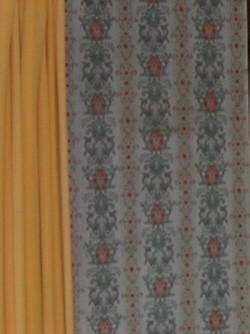
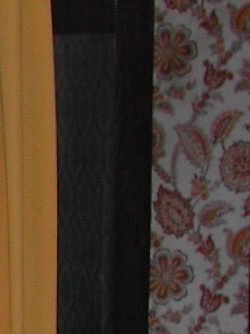
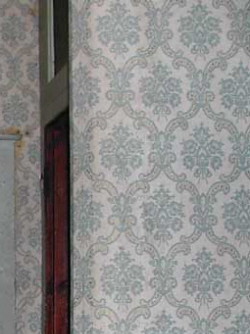
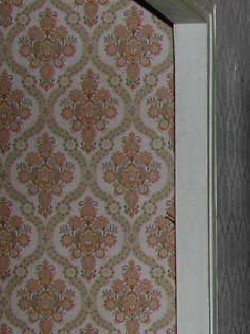
Those above all came from the ground floor. The following were the first floor offerings.

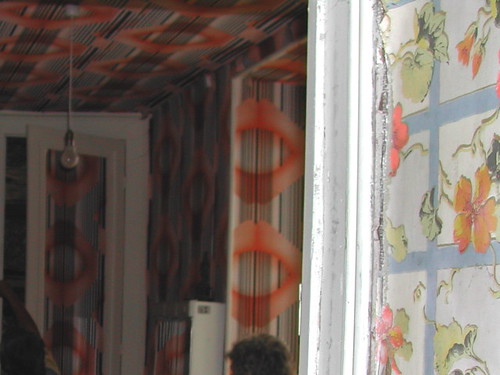
The huge lips (I can't think of any other description) appeared in the bathroom.
Believe me, the wallpaper was the least of the problems! You might wonder why we bought the place - the views are why:
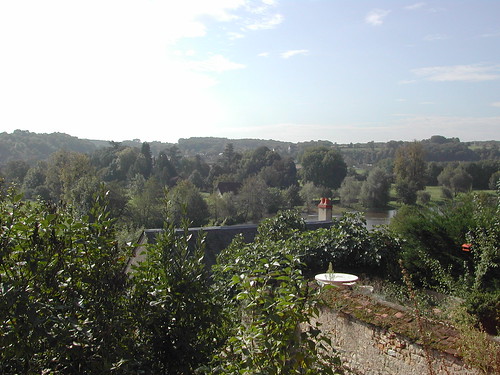
and from the bedroom:

The weather has been horrible so I've been browsing through all the pictures we took when we first found the house where we now live. These are examples of the wallpaper we found, cropped from general pictures we took to remind ourselves later, so the quality isn't wonderful.
Those above all came from the ground floor. The following were the first floor offerings.
The huge lips (I can't think of any other description) appeared in the bathroom.
Believe me, the wallpaper was the least of the problems! You might wonder why we bought the place - the views are why:
and from the bedroom:
Saturday, 26 May 2007
PhotoHunter: colourful

In haste as we've just arrived, it's already late afternoon here, and I have a load of translation to do. Still, there are some people who are just starting the day!
So there we have a bunch of my husband's ties waiting to be packed, though now of course they're waiting to be unpacked ...
Not only do I think he is colour-blind, but I strongly suspect pattern-blind as well.
Thursday, 24 May 2007
Travelling
Yes, this time we are definitely travelling. We leave tomorrow and will arrive in our part of France some time on Saturday.
Why is it the things to be packed occupy twice the volume of the available space?
Why is it the things to be packed occupy twice the volume of the available space?
Wednesday, 23 May 2007
Too many women
Some time ago a couple of articles, one in the Journal of Acquired Immune Deficiency Syndromes and the other in Pediatrics, were published which demonstrated that in Africa more female babies than male babies were born infected with HIV . There could be two reasons for this: first that female foetuses were more susceptible to HIV infection than males, or secondly, that just as many male foetuses were infected but that they perished before being born, resulting in spontaneous abortions.
The latter reason appeared to be the case and would tie in with a study of elderly patients which suggests that men with particular genotypes may be less likely to survive.
I cannot find any further reference to this study of HIV infections leading to a higher birth rate of females but it seems to me that there are huge implications because of the resulting distortion of gender balance in the normal population.
Already in many African countries, women are having to shoulder the burdens left by war and AIDS.
In Swaziland, many farms have been left in the hands of women as a result of the world's highest HIV/AIDS infection rate. Until last year women were not allowed either own property or open a bank account.
In Mozambique, 30% of households are headed by women but although poverty has declined by 18%, in the female households it has declined by only 4%.
In Kenya, women are more likely to be illiterate (leading to ignorance) and living in poverty and this increases the likelihood of HIV infection. Cases in four districts had doubled to 20,000 and most of them women. Only 30% of women believe HIV could be avoided.
And of course, if there is a disproportionate number of women in the population, in some societies this could lead to an increase in female genital mutilation, in order to ensure the “attractiveness” of young women to the fewer potential husbands. A very full report on FGM can be found on the Integrated Regional Information Network (IRIN) website. IRIN is part of UN Office for the Coordination of Humanitarian Affairs.
The latter reason appeared to be the case and would tie in with a study of elderly patients which suggests that men with particular genotypes may be less likely to survive.
I cannot find any further reference to this study of HIV infections leading to a higher birth rate of females but it seems to me that there are huge implications because of the resulting distortion of gender balance in the normal population.
Already in many African countries, women are having to shoulder the burdens left by war and AIDS.
In Swaziland, many farms have been left in the hands of women as a result of the world's highest HIV/AIDS infection rate. Until last year women were not allowed either own property or open a bank account.
In Mozambique, 30% of households are headed by women but although poverty has declined by 18%, in the female households it has declined by only 4%.
In Kenya, women are more likely to be illiterate (leading to ignorance) and living in poverty and this increases the likelihood of HIV infection. Cases in four districts had doubled to 20,000 and most of them women. Only 30% of women believe HIV could be avoided.
And of course, if there is a disproportionate number of women in the population, in some societies this could lead to an increase in female genital mutilation, in order to ensure the “attractiveness” of young women to the fewer potential husbands. A very full report on FGM can be found on the Integrated Regional Information Network (IRIN) website. IRIN is part of UN Office for the Coordination of Humanitarian Affairs.
Sunday, 20 May 2007
French kisses
I don't have a particular problem normally with Papillon's posts. They are extremely well written and she uses fairly standard (lovely to my ear) language, though she quite often plays on words. But today she had me floored. For the operation they put a charlotte on her head? I knew what she meant but I couldn't decide whether she was making a joke or whether it was a technical term :) I got there in the end though, but it took some considerable googling. All my usual sources let me down.
It's usually the comments which give me the most difficulty, partly because of the casual language often used and partly because commenters don't normally "compose" their comments and they can be full of typos which can send me off on a wild goose chase.
But what gives me the most difficulty of all are the numerous ways the French kiss you! So far twenty different ways:
It's usually the comments which give me the most difficulty, partly because of the casual language often used and partly because commenters don't normally "compose" their comments and they can be full of typos which can send me off on a wild goose chase.
But what gives me the most difficulty of all are the numerous ways the French kiss you! So far twenty different ways:
- allez bizzzzz
- bises
- bisous
- biz
- biz amilcales
- bizou
- de grosses bises
- des bises
- des bises plein
- gros bisous
- gros, énormes bisous
- je me permets une bise
- je te fais de gros bises
- je te fais un gros bizou
- je t'embrasse
- je t'embrasse très fort
- mille baisers à toi
- tout plein de bisous
- un énorme bisou
- une bise sur chaque joue
- all used as signing off a comment, and I can't think of one way of saying it in English without sounding, well, really odd, not to mention repeating myself.
Saturday, 19 May 2007
PhotoHunter: Cooking
 I wasn't expecting to be able to post this weekend, but the travelling has been postponed for another week so I've rushed around and come up with this: our old family recipes, mostly hand-written and passed on. There are recipes there from my great-aunt (1899-1988), my mother, my mother-in-law, my cousin, my sister. We all love cooking.
My great-aunt was a fantastic cook and obsessive recipe collector. She and my grandmother ran the Lakeview Cafe many years ago, and my great-aunt did all the cooking and baking herself. My grandmother was a good cook too but she ran the business side of things and left her sister to be the creative one.
"The most indispensable ingredient of all good home cooking: love, for those you are cooking for."
— Sophia Loren
"If a pot is cooking, the friendship will stay warm"
— Arab proverb
Wednesday, 16 May 2007
Short pause
Today Papillon will have had her operation. She returns home tomorrow but I can't imagine she will post for a day or two.
It has coincided with our return to France so I am unlikely to be posting again before Saturday evening, if then. But I won't have forgotten.
It has coincided with our return to France so I am unlikely to be posting again before Saturday evening, if then. But I won't have forgotten.
Shiraz said:
I have realised that I have missed some comments from Papillon's blog. I don't always notice them if they appear several days after the original post. I noticed this one which I thought worth a post of its own. Shiraz, the commenter, didn't leave a link.
Dear Papillon
What a coincidence that the question you ask here is exactly the question of the year for me! In fact, I haven’t been circumcised, but the question affects me personally because, as a result of the environment in which I was born (Moslem, not fundamental but practising) I have always felt circumcised in my head.
Although my family is very “modern” as far as the status of women is concerned at work for example, I have been expressly forbidden from being too close to men, and to avoid having these problems I prevented my femininity from blossoming freely, I succeeded in forgetting I had a body because it was of no use.
I believe that physical circumcision is the most extreme expression of the repression of women’s bodies, and I do not see how one can be feminine, accept yourself as a woman, if our environment refuses to let us enjoy our own bodies. In wanting to kill femininity, these societies only make themselves sick.
To answer your question, Papillon, it’s several years now that I have been following “body therapies” such as yoga, tai chi, chiropractic, to put myself back in touch with my body.
As for femininity itself, I’ve made some fascinating discoveries this year since being in England. I’ve discovered “pagan” communities, inheritors of Celtic traditions where, like all pre-monotheist civilisations, Woman is held in high esteem, and each woman is considered to be the image of the Goddess. I am not criticising monotheist religions, but since I rediscovered these traditions, I am immersing myself in all sorts of books which suggest “archetypes” which we can refer to as we develop ourselves as women., in effect, consider that there are the goddess-mother, the goddess-warrior, the goddess-priestess, and they are all WOMEN. I don’t intend becoming a pagan priestess, far from it, but I think that immersing yourself in this ancient wisdom allows you to build mental models, which are universal because everlasting, and which you don’t necessarily find within your family.
So, it was very long, but I hope it makes sense!! Thank you for your blog, and I will be thinking of you very, very much on 16 May!
Monday, 14 May 2007
The Week of the Butterfly

This week, on Wednesday 16 May, Papillon will have her operation, the reconstructive surgery to repair the damage done by circumcision carried out when she was four years old.
If you haven't read the account of her journey this far, her blog is called "Le Chemin de ma reconstruction" and can also be read in English here.
Sunday, 13 May 2007
The Razor's Edge
If you click on this link you can download a video file called The Razor's Edge: the Controversy of Female Genital Mutilation, produced by IRIN, the UN Office for the Coordination of Humanitarian Affairs
You may not want to: it does not make easy viewing. The text is here if you feel you can't watch.
You may not want to: it does not make easy viewing. The text is here if you feel you can't watch.
Perpetuating stereotypes
On Friday I was reading a post on NHS Blog Doctor, all about a new system whereby patients book their own hospital appointments. While he complains about the system, which is dubious I grant you, he uses as illustration a fictitious patient called Doris, aged 70. And then comes up with this:
"An intelligent middle class, middle aged patient will make light work of the letter. An old, not so clever widow in her seventies does not understand it. "
Then I read the comments, the first of which was:
"I can barely make sense of that form, so I'm not sure how your patient was supposed to! : Nurse 11.05.07 - 9:45 pm "
I'm not sure whether the nurse making the comment has superior form-interpretation skills by virtue of the fact that he is male or purely because of his/her occupation.
I left a comment objecting to the use of an "old, not so clever widow" as an example but it seems that nobody can see how it perpetuates stereotypes. Repeating that sort of thing just reinforces preconceptions, and I am heartily sick of being assumed to be some sort of an idiot by professions. The excuse eventually given seems to be that he has large numbers of female patients:
"Like most GPs, I have a large number of elderly women with medical problems. A lot of them are widows. Some of them could do battle with Germaine Greer and Beryl Bainbridge. Some of them could not. Even a lot of the highly intelligent competent ones struggle with paperwork as they have never done it in their lives. Some of my male widower patients struggle with cooking - their wives always did it and now they cannot boil an egg. They struggle even more if they are not too intelligent."
Is he saying, he is certainly implying, that all the males could cope with paperwork? Was it necessary to single out a section of his patients as likely not to be able to manage?
"An intelligent middle class, middle aged patient will make light work of the letter. An old, not so clever widow in her seventies does not understand it. "
Then I read the comments, the first of which was:
"I can barely make sense of that form, so I'm not sure how your patient was supposed to! : Nurse 11.05.07 - 9:45 pm "
I'm not sure whether the nurse making the comment has superior form-interpretation skills by virtue of the fact that he is male or purely because of his/her occupation.
I left a comment objecting to the use of an "old, not so clever widow" as an example but it seems that nobody can see how it perpetuates stereotypes. Repeating that sort of thing just reinforces preconceptions, and I am heartily sick of being assumed to be some sort of an idiot by professions. The excuse eventually given seems to be that he has large numbers of female patients:
"Like most GPs, I have a large number of elderly women with medical problems. A lot of them are widows. Some of them could do battle with Germaine Greer and Beryl Bainbridge. Some of them could not. Even a lot of the highly intelligent competent ones struggle with paperwork as they have never done it in their lives. Some of my male widower patients struggle with cooking - their wives always did it and now they cannot boil an egg. They struggle even more if they are not too intelligent."
Is he saying, he is certainly implying, that all the males could cope with paperwork? Was it necessary to single out a section of his patients as likely not to be able to manage?
Friday, 11 May 2007
PhotoHunter: five
I'm staying on a nostalgia theme, but two different offerings: first my father in law (centre) as one of five aircrew during the Second World War, dated 1940.

Then my father - five pictures of him, from 10 years old to 75 years old. The centre one is of him in the Royal Army Medical Corps in North Africa, dated about the same time as my father in law's above.

First: in Dublin as a schoolboy
Second: in Dublin as a student
Third: in North Africa
Fourth: as I remember him best
Fifth: Golden Wedding celebration

Then my father - five pictures of him, from 10 years old to 75 years old. The centre one is of him in the Royal Army Medical Corps in North Africa, dated about the same time as my father in law's above.

First: in Dublin as a schoolboy
Second: in Dublin as a student
Third: in North Africa
Fourth: as I remember him best
Fifth: Golden Wedding celebration
Everyone has a story to tell
When we first moved from our lovely-place-in-the-country-which-I-miss, we had an elderly dog. City life was a shock to her system, and to mine in a way, because walking her became a bigger event than just opening the back door and wandering off into the woods.
One of the places we used to walk was a cemetery. It’s a very green cemetery, being nurtured and let go wild (if that's not a contradiction in terms) to reproduce a local habitat. As I used to wander around, especially as poor old Daisy became slower and slower, I used to look at the graves and wonder about the stories which could be told, and thought how sad it was that the majority wouldn’t be.
It was what prompted me to encourage my mother to put down some of her memories, but she ran out of steam after the first instalment. She is the only member of that generation left in our family so it seems important to record her thoughts and impressions of some quite memorable times. Since then I have been rummaging through old family photos and again this made me think of the stories behind them. Fortunately one of my sons has been talking to his grandmother about it too, and so she has started up once more.
People never think their own lives are in any way interesting but they are. My mother lived through WWII, and as soon as it ended in Europe, decided to join my father in Italy where he was serving in the army of occupation. If she’d asked permission she would never have been allowed …. Then about five years later she once again had to follow my father, this time to Africa and with two babies in tow, only to find he wasn’t where she thought he was. She doesn’t think she has anything of note to write about.
When we lived in Paris, I met a number of elderly women who had married into French families before the war. Some of them had the most fascinating things to relate to anyone who would sit down and listen, but whether they were ever recorded I don't know. It's truly a shame if not.
I’ve been to see the Anne Frank and You exhibition which is touring around. It’s main purpose is to encourage young people to think about tolerance, freedom and justice, but a secondary aim could be to encourage people to record their thoughts for posterity.
It may not seem important to make a record at the time, but it grows in importance as years pass, and has special significance for families. To some extent people are doing it in blogs, but will your children know where to find them?
[Inspired also by Lapis Ruber's biography]
One of the places we used to walk was a cemetery. It’s a very green cemetery, being nurtured and let go wild (if that's not a contradiction in terms) to reproduce a local habitat. As I used to wander around, especially as poor old Daisy became slower and slower, I used to look at the graves and wonder about the stories which could be told, and thought how sad it was that the majority wouldn’t be.
It was what prompted me to encourage my mother to put down some of her memories, but she ran out of steam after the first instalment. She is the only member of that generation left in our family so it seems important to record her thoughts and impressions of some quite memorable times. Since then I have been rummaging through old family photos and again this made me think of the stories behind them. Fortunately one of my sons has been talking to his grandmother about it too, and so she has started up once more.
People never think their own lives are in any way interesting but they are. My mother lived through WWII, and as soon as it ended in Europe, decided to join my father in Italy where he was serving in the army of occupation. If she’d asked permission she would never have been allowed …. Then about five years later she once again had to follow my father, this time to Africa and with two babies in tow, only to find he wasn’t where she thought he was. She doesn’t think she has anything of note to write about.
When we lived in Paris, I met a number of elderly women who had married into French families before the war. Some of them had the most fascinating things to relate to anyone who would sit down and listen, but whether they were ever recorded I don't know. It's truly a shame if not.
I’ve been to see the Anne Frank and You exhibition which is touring around. It’s main purpose is to encourage young people to think about tolerance, freedom and justice, but a secondary aim could be to encourage people to record their thoughts for posterity.
It may not seem important to make a record at the time, but it grows in importance as years pass, and has special significance for families. To some extent people are doing it in blogs, but will your children know where to find them?
[Inspired also by Lapis Ruber's biography]
A vicious circle
In Africa, one of the most straightforward ways of establishing HIV infection rates is by screening pregnant women when they attend ante-natal clinics. For some however this appears to promote the idea that there is a link between HIV infection and women, and this is reinforced when the statistics are quoted, as they often are. In addition many don’t realise they are HIV positive until they are screened so the first a family may know of their HIV status is through the mother.
Disastrously, in Mozambique it has led to women who find they are HIV positive being abandoned by their families. Because they fear what might happen, women are either refusing to be tested, or hiding their HIV status from their husbands and families. In both cases, those that need anti-retroviral drugs and help in preventing mother to child transmission are not receiving them, nor are they able to take precautions against further spread of the virus.
It is estimated there are 30,000 HIV positive babies born every year in Mozambique.
Original report from IRIN
Disastrously, in Mozambique it has led to women who find they are HIV positive being abandoned by their families. Because they fear what might happen, women are either refusing to be tested, or hiding their HIV status from their husbands and families. In both cases, those that need anti-retroviral drugs and help in preventing mother to child transmission are not receiving them, nor are they able to take precautions against further spread of the virus.
It is estimated there are 30,000 HIV positive babies born every year in Mozambique.
Original report from IRIN
She's OK!!!
What a relief! I've just had a call from my friend, still at the hospital, but she's been told that it's benign.
So now she can stop cleaning her house. I wish I had such a useful displacement activity: I've just been reading thrillers to keep my mind off things.
So now she can stop cleaning her house. I wish I had such a useful displacement activity: I've just been reading thrillers to keep my mind off things.
Wednesday, 9 May 2007
My friend
My friend and colleague rang me at 7:00 this morning in tears, and I'm trying to fight them back just now.
Some weeks ago she found a lump in her breast. She has had a mammogram, ultrasound, biopsies, and then 10 days ago they took her in for a small operation to remove part of the lump. She has an appointment on Friday for the results.
She rang this morning because during the night she found another lump. I tried to reassure her. I've been talking to her all day although I really don't know what to say.
She'll either be feeling very much better by Friday afternoon, or she won't. I'll either be feeling very much better, or I won't. I've realised how very much I care about her.
Some weeks ago she found a lump in her breast. She has had a mammogram, ultrasound, biopsies, and then 10 days ago they took her in for a small operation to remove part of the lump. She has an appointment on Friday for the results.
She rang this morning because during the night she found another lump. I tried to reassure her. I've been talking to her all day although I really don't know what to say.
She'll either be feeling very much better by Friday afternoon, or she won't. I'll either be feeling very much better, or I won't. I've realised how very much I care about her.
Tuesday, 8 May 2007
Feeling threatened
The other day we had a collapsed laptop. I called out the engineer (it was still under warranty) and he arrived at 5:30 when most staff were leaving to go home. By 7:00 pm he had put it back together again but hadn't reinstalled any of the software so I told him, no problem, I would take it home and finish it off.
He insisted on writing a note of explanation to our IT department (that's me, but he couldn't seem to comprehend that) and then left. I packed everything up and set off for one of the more distant car-parks.
I noticed a bunch of young teenagers roaming around. I drove off and then saw the rubbish skips which had been pushed across the entrance and exit to the car-park. There was no way I would be able to move them but as well there was no way was I going to leave the car, so I had to turn back to try to find a security guard.
Why is it they are always around, often with dogs, noticing missing parking permits during the daytime but in the evening when you might need them, they are nowhere to be seen?
He insisted on writing a note of explanation to our IT department (that's me, but he couldn't seem to comprehend that) and then left. I packed everything up and set off for one of the more distant car-parks.
I noticed a bunch of young teenagers roaming around. I drove off and then saw the rubbish skips which had been pushed across the entrance and exit to the car-park. There was no way I would be able to move them but as well there was no way was I going to leave the car, so I had to turn back to try to find a security guard.
Why is it they are always around, often with dogs, noticing missing parking permits during the daytime but in the evening when you might need them, they are nowhere to be seen?
Monday, 7 May 2007
Patronising or worse
This is not intended to be a personal attack on anyone in particular.
Recently I have come across blogs which give the impression that some doctors appear to have a very low opinion of their patients. There is a self-congratulatory tone from some which I find disquieting. There is something of an echo in this in Papillon's most recent post when she went to see her anaesthetist, Dr Icecube.
I come from a medical family. I have known doctors socially, have worked for many of them, and have even consulted them. Some of them are idiots (oh, sacrilege) and some of them are wonderful people.
I am capable of understanding quite a lot. I am capable of reading a newspaper report and thinking that it's rubbish, or only partly true. I am capable of finding original research where appropriate. I am not the only one: don't treat us, your patients, like some sort of idiots just because our backgrounds are not the same as yours.
Please treat others as you would like to be treated. Controversial, I know.
Recently I have come across blogs which give the impression that some doctors appear to have a very low opinion of their patients. There is a self-congratulatory tone from some which I find disquieting. There is something of an echo in this in Papillon's most recent post when she went to see her anaesthetist, Dr Icecube.
I come from a medical family. I have known doctors socially, have worked for many of them, and have even consulted them. Some of them are idiots (oh, sacrilege) and some of them are wonderful people.
I am capable of understanding quite a lot. I am capable of reading a newspaper report and thinking that it's rubbish, or only partly true. I am capable of finding original research where appropriate. I am not the only one: don't treat us, your patients, like some sort of idiots just because our backgrounds are not the same as yours.
Please treat others as you would like to be treated. Controversial, I know.
A whole day of indulgence

I was given a day in a health spa as a birthday present some time ago and I wanted to use it before we go back to France in 10 days' time (already? I need to start preparing!). I don't really consider health spas to be my scene but I booked ahead and duly set off yesterday.
The first challenge was finding the place. It's very deep in the heart of the countryside but it's a countryside I know quite well, so I couldn't believe how long it took to find it. A few signposts wouldn't go amiss. I arrived to find that premium guests, whatever that means, can park outside the front entrance but everyone else has to go round the back. I managed to squeeze into Park D at just about the furthest limit. Not a premium guest then.
Nevertheless in spite of the inauspicious start, I enjoyed my day. I had no idea what to expect. The surroundings weren't quite as luxurious as the promotional literature would have you believe, nor the reception staff quite as professional. The thalassotherapy was fun and invigorating, the massage and facial were (surprisingly) relaxing. I also managed to fit in two swimming sessions, a brisk lakeside walk, and plenty of reading. Lunch was in a restaurant with a beautiful view overlooking the lake. The main course was very good but the pudding, always my favourite part, tasted like Instant Whip.
I am sorry to say I found I was nowhere near as fit as I used to be when I had a dog to walk all the time, so by the end of the day I was exhausted. But I slept well last night.
Friday, 4 May 2007
PhotoHunter: Childhood
Inspecting the new addition to my childhood.


Our childhood was spent in Africa: here on the steps in Chisenga with me, as ever, slightly apart.
There was a little girl,
And she had a little curl,
Right in the middle of her forehead;
When she was good she was very, very good,
When she was bad she was horrid.
And she had a little curl,
Right in the middle of her forehead;
When she was good she was very, very good,
When she was bad she was horrid.
(mainly the latter, or so I was told rather frequently)
In the garden, Karonga.
PS My hair is darker and even curlier now and I do NOT like it!
Breast cancer awareness
From the University of Oxford news of a study which questioned almost 1500 women and found that they were unaware of the increasing risk of breast cancer caused by age.
They were given a choice of 10-year age bands and had to choose where the greatest risk lay. 99% of the women questioned answered incorrectly, 56% saying age doesn’t matter. Only 0.7% answered correctly that a woman in her 80s had the highest risk.
Age is the strongest risk factor for breast cancer, with the chance being 1 in 25 compared with 1 in 70 for a woman in her 40s. The researchers think that the confusion is partly the “Kylie” effect of publicity for younger, well-known women who have been diagnosed, and partly because routine screening is offered only up to the age of 70 in the UK, even though an older woman can request an appointment.
The study was funded by Cancer Research UK and the Breast Screening Programme.
When you couple this with the very recent report from the University of Manchester which highlights a lower level of care for older women, things start to look very depressing for older women. They are likely to present late, and receive worse care when they do. The Manchester study found that women over 80 compared with women between 60 and 69 are less likely to:
The main drawback of this study would seem to be that they didn’t take into account the preferences of the patients which may have a considerable bearing on the results, but with the population aging as it is, and with people staying fitter and more active longer, it is important that women realise that they are at increased risk and do continue to be vigilant, and that they receive the care and attention they need if they do need treatment.
I do believe, at least among the general public, there is an attitude that sees disease in old age as inevitable and hardly worth treating. I remember when my father in law died from a heart condition people were inclined to shrug as if to say, “well he’s old” whereas one imagines they would express more concern for a younger person. This must inevitably mean that more money/effort will go to charities funding research into areas which are perceived as problems for younger people, breast cancer included it seems. I recently came across someone who had been for a cervical smear test and had met a woman there in her eighties. To my horror my acquaintance expressed surprise and said “at that age, why bother?”
They were given a choice of 10-year age bands and had to choose where the greatest risk lay. 99% of the women questioned answered incorrectly, 56% saying age doesn’t matter. Only 0.7% answered correctly that a woman in her 80s had the highest risk.
Age is the strongest risk factor for breast cancer, with the chance being 1 in 25 compared with 1 in 70 for a woman in her 40s. The researchers think that the confusion is partly the “Kylie” effect of publicity for younger, well-known women who have been diagnosed, and partly because routine screening is offered only up to the age of 70 in the UK, even though an older woman can request an appointment.
The study was funded by Cancer Research UK and the Breast Screening Programme.
When you couple this with the very recent report from the University of Manchester which highlights a lower level of care for older women, things start to look very depressing for older women. They are likely to present late, and receive worse care when they do. The Manchester study found that women over 80 compared with women between 60 and 69 are less likely to:
- have a triple assessment (clinical evaluation, imaging, cytology/histology)
- receive surgery
- have a steroid receptor test to assess the efficacy of tamoxifen
- if they do have surgery they are less likely to have radiotherapy
The main drawback of this study would seem to be that they didn’t take into account the preferences of the patients which may have a considerable bearing on the results, but with the population aging as it is, and with people staying fitter and more active longer, it is important that women realise that they are at increased risk and do continue to be vigilant, and that they receive the care and attention they need if they do need treatment.
I do believe, at least among the general public, there is an attitude that sees disease in old age as inevitable and hardly worth treating. I remember when my father in law died from a heart condition people were inclined to shrug as if to say, “well he’s old” whereas one imagines they would express more concern for a younger person. This must inevitably mean that more money/effort will go to charities funding research into areas which are perceived as problems for younger people, breast cancer included it seems. I recently came across someone who had been for a cervical smear test and had met a woman there in her eighties. To my horror my acquaintance expressed surprise and said “at that age, why bother?”
Thursday, 3 May 2007
Greetings cards come of age
Some months ago (prehaps more than a year) I had to buy a card for a colleague who was retiring. He was a very active man, looking forward to doing even more with his retirement, so it was with horror that I saw the types of cards available. They all seemed to be rocking-chair-by-the-fireside types and totally unsuitable.
So today, which was otherwise unremittingly awful, there was a bright interlude when I found this card. Please take note anyone out there who wants to send me a birthday card - this is the sort of thing I want!

So today, which was otherwise unremittingly awful, there was a bright interlude when I found this card. Please take note anyone out there who wants to send me a birthday card - this is the sort of thing I want!

And here is one I am going to have to save for six months, though by that time I will have forgotten all about it and bought another which I won't like.

Wednesday, 2 May 2007
Life's Gifts 1890
by Olive Schreiner.
I came across this at Equiano’s Lost in Translation, a largely African orientated book blog. It comes from Dreams by Olive Schreiner (1855-1920) which is available for download from Project Gutenberg amongst other places.
A timeless piece.
I came across this at Equiano’s Lost in Translation, a largely African orientated book blog. It comes from Dreams by Olive Schreiner (1855-1920) which is available for download from Project Gutenberg amongst other places.
I saw a woman sleeping. In her sleep she dreamt Life stood before her, and held in each hand a gift--in the one Love, in the other Freedom. And she said to the woman, "Choose!"
And the woman waited long: and she said, "Freedom!"
And Life said, "Thou hast well chosen. If thou hadst said, 'Love,' I would have given thee that thou didst ask for; and I would have gone from thee, and returned to thee no more. Now, the day will come when I shall return. In that day I shall bear both gifts in one hand."
I heard the woman laugh in her sleep.
A timeless piece.
One in fifty births end in the mother’s death
That’s what happens in Sierra Leone. It’s an almost unbelievable number, about 200 times higher than it would be in a developed country. To put it another way, a woman has a one in six chance of dying in childbirth. And then, one in six babies die.
There are several different reasons for these awful figures, but one of the factors is female circumcision which is almost universal in Sierra Leone. Other issues are the use of traditional medicine which can be hazardous; the cost of healthcare where many live in poverty (in spite of the country being gold and diamond rich); lack of skilled personnel; lack of equipment.
The only country lower on the UN’s Development Index is Niger.
Full report from IRIN.
There are several different reasons for these awful figures, but one of the factors is female circumcision which is almost universal in Sierra Leone. Other issues are the use of traditional medicine which can be hazardous; the cost of healthcare where many live in poverty (in spite of the country being gold and diamond rich); lack of skilled personnel; lack of equipment.
The only country lower on the UN’s Development Index is Niger.
Full report from IRIN.
Subscribe to:
Posts (Atom)
LinkWithin
