
And a different view we got. We started to see boulders here and there along the side of the roads perched in unusual places and at unusual angles, even in gardens and between houses. Where there were fields they weren't hedged or fenced, they were lined with stone blocks.

Then I spotted a sign and it had to be followed.
 |
| Picture from here |
A chaos, in this situation, is a jumble of rocks as you can see from the following picture. Enormous but smooth and rounded boulders, hundreds of them. As I was taking this picture I could hear loud booms in the distance. Mining?

I couldn't resist investigating the cave of St Dominic. The arrow pointed down this way.

By this time we had gathered companions, a couple who went striding on down the path, and an elderly lady in flip-flops. The elderly lady picked her way very gingerly through the rocks, pausing frequently. Just to make conversation I said something about it being even worse on the way back up. But, no, apparently she would prefer the return up hill because when she fell she had something to fall against. Oh, great.
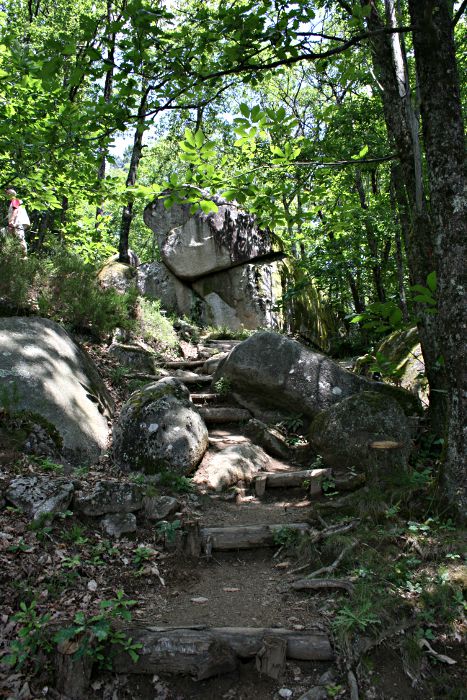
These were the "steps", in places more lethal than clambering down the rocks. The figure at the top is one of the couple who had marched on ahead. Nothing to see, they said, all there is is the sound of rushing water. So we believed them. I was quite relieved to get the old lady back up the hill in once piece.
 |
| Picture from here |
It wasn't until I later did some research that I found what it was we should have been looking for. There is an entrance into a cave with two further caves leading off it. I doubt whether I would have attempted to go in anyway but I wish I had persisted all the same.
The cave supposedly had been used by Dominic, later to become St. Dominic, when he was hiding from crusades against the Cathars, a strand of Christianity the Catholic Church considered heretical in the 12th century.

This, the Peyro Clabado,is thought to be about 800 tons of solid granite. There were many more strangely shaped and balanced rocks all over the area but once you've seen a few, you've seen them all.
The explosions I heard were coming from a nearby granite works. The whole region's economy depends on granite and it's one of the major producers in France. The rock used for pavements, airport runways, gravestones. The Grande Arche de la Défense is lined with granite from Sidobre.
Increasingly, as competition from China becomes more important, tourism is being encouraged. It surprises me that it's not better known already because Carcassonne, one of the major tourism magnets in the area, is no distance away.


