Showing posts with label Ireland. Show all posts

Sunday, 17 March 2013

Food for St Patrick's Day


When I was a child in Ireland we traditionally had colcannon and boiled bacon on 17 March, St Patrick's Day.  Both could be eaten throughout the year but they were our special St Patrick's Day treat.

Colcannon is a dish made from potatoes and kale or cabbage, plus a few other ingredients.  For St Patrick's Day my grandmother would hide a thimble, or more usually for us, a threepenny piece (a thruppenny bit) inside, bringing luck, pots of gold and anything else you could think of to the finder. Strangely there were always two threepenny pieces and even more strangely, each grandchild would find one.

I decided to make myself some colcannon.  Simplicity itself:

4-6 large potatoes
250 g or 8oz chopped and cooked kale (or cabbage/greens)
6-8 spring onions, scallions or chives, chopped
milk (or cream)
butter
salt and pepper

Soften scallions in some butter.  Boil the potatoes and mash with milk or cream until fairly smooth.  Add spring onions, kale, salt and pepper and mix.  Put into an oven proof bowl, make a well in the top of the colcannon and put as much butter as you can into the well.  Place in the oven until everything is piping hot.  I like mine to brown slightly on top.


Served with a slice of boiled bacon, or ham, or fried if you must.  Delicious and it takes me back all those years and all those miles.


Lyrics [and translation]:


Well did you ever make colcannon,
Made with lovely pickled cream [buttermilk]
With the greens & scallions mingled
Like a picture in a dream
Did you ever make the hole on top
To hold the meltin' flake
Of the creamy flavoured butter
That our mothers used to make

Oh you did, so you did
So did he and so did I
And the more I think about it
Sure the nearer I'm to cry
Oh weren't them the happy days
When troubles we knew not
And our mothers made colcannon
In the little skillet pot.

Well, did you ever take potato cake [flat bread made from potato and flour]
And boxty to the school [fried mashed and grated potato]
Tucked underneath your oxter with [armpit]
Your books, your slate and rule
And when teacher wasn't looking'
sure a great big bite you'd take
Of the creamy flavoured soft and meltin'
sweet potato cake
.
.
.
Well did you ever go a courtin' boys
When the evenin' sun went down
And the moon began a peepin'
From behind the Hill O' Down
And you wandered down the boreen [rural lane]
Where the clúrachán was seen [leprechaun]
And you whispered love and praises to
Your own dear sweet cáilín [young girl(colleen)]

Oh you did, so you did
So did he and so did I
And the more I think about it
Sure the nearer I'm to cry
Oh weren't them the happy days
When troubles we knew not
And our mothers made colcannon
In the little skillet pot.
Enhanced by Zemanta

Tuesday, 4 May 2010

Empty houses

Photo from Flickr/kathybragg

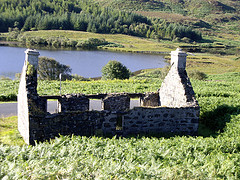
One of the abiding memories I have of the Ireland of my childhood is of the countryside dotted with empty houses, most in ruins. My grandmother told me it was the result of the potato famine and the general emigration from Ireland which has happened in waves before and since then. In fact emigration from Ireland has been going on ever since the 17th and 18th centuries.

When Ireland joined the European Union, the country went through an enormous boom. Money was pouring into the country, jobs were plentiful and immigrants were attracted from other parts of Europe. House prices rose accordingly.

With the recession the property bubble has come to a catastrophic end. The property market has been banjaxed, as my father would have said. There are empty houses once again in Ireland. They aren't the old stone-built country cottages, they are in modern estates, now referred to as ghost estates. One in five houses in Ireland is unoccupied. Even if every Irish person in need of a home were to be given one, there would still be many left over.

This is partly the result of over-build spurred on by visions of easy gains. Planners were allowing the development, bankers were lending the money to enable it to happen. Then it all stopped.

Not only did the money stop flowing, the influx immigrants slowed right down and many returned home. Now unemployment is rising sharply, and more and more Irish are emigrating again. The difference now is that it was so unexpected to the generation most affected.
Reblog this post [with Zemanta]

Wednesday, 31 October 2007

Halloweens I have known

Most of my childhood was spent in Africa where we didn't celebrate Halloween at all. It was celebrated, though, in Ireland when we returned to visit the grandmothers, but really consisted only of a few party games for children, no dressing up in elaborate costumes, no pumpkins - we carved turnips instead, the big yellow turnips which I now know as swedes (with a small s all you sensitive Scandinavians), not the small white ones. I look back with great fondness to our grandmother and her sister who made considerable efforts to "educate" the little heathens in the traditions of our forebears.

The party games I recall seemed to revolve around apples:


  • bobbing for apples - you had to try to catch apples floating in a bowl of water in your teeth, no hands allowed. My memory is that you end up getting wet.

  • snap apples - again you had to catch an apple in your teeth but this time they were suspended on a string in a doorway. This time you end up with bruised lips.

We would have a special meal which included colcannon (mashed potatoes mixed with curly kale and spring onions) and barm brack (a fruit bread/cake), either or both of which could have a ring or a coin hidden inside.

During my teenage years in England, there seemed to be little celebration of Halloween, instead the emphasis was on Guy Fawke's Day on 5 November, about which more nearer the event.

France in theory disapproves of Halloween as being from another culture. Nevertheless it is creeping in, and the last two years we have had a few little children knocking on the door for treats. I know the family they come from and I suspect ours may be the only door they knock, so they'll be disappointed we aren't there this year. The big day in France is 1 November, a public holiday and a great family day, when everyone puts flowers, chrysanthemums, on family graves.

Barm brack recipe from my grandmother's recipe book (exactly as it is written)

1lb self raising flour
1lb mixed fruit
1 breakfast cup of warm strong tea
3/4 breakfast cup Demerara sugar
1 large egg
1 full teaspoon spice


Put sugar and fruit in a bowl, cover with tea and leave steeping overnight. Next day beat egg and add to tea and fruit, work in flour and lastly spice, beating well. Bake Reg 5, 1 and quarter hours. Cover after 20 minutes and remove cover 15 minutes before finished.

If you try it, enjoy it!

Updated to add that the Halloween header is courtesy of Gattina. Thanks very much Gattina.

Other Halloween celebrations in Sweden, Waterloo in Belgium, Barcelona

Wednesday, 30 May 2007

Irish language

Earlier today I was reading a post on Charlotte’s Web, Adults Speak with Forked Tongue. It was discussing the lies told by adults to children which was interesting in itself, but it was when I got to the part about the headmistress’ end of year report that the memories came flooding back.

The one that first came to mind was my Irish teacher, teacher of the Irish language, that is. Because of all our travels I only intermittently attended school in Ireland, but Irish was a compulsory subject. That was tricky because it wasn’t something I could keep going anywhere else. and as a result I didn’t exactly shine.

I hated it. I was terrified of most of the teachers at that school and the Irish teacher was the most terrifying. I pleaded to be put down into the lower group for my Irish lessons but no one would support me. I was in that class for approximately six months, during which time the teacher never worked out who I was. She would mark our homework and tests and ask us to read out our marks so that she could write them into her register. My name was never called. I would tell her I’d been missed, she wouldn’t find me on the list, and so it went on. After this happened, oh at least twice, I stopped volunteering myself. Who wanted to read out appalling marks for the rest of the class to snigger over?

At the end of term she was sitting at the front filling in report sheets for everyone, when suddenly “Who is A?” I could see no way round it, I put up my hand, quaking. She stared at me as though she had never seen me before, looked at her register, flipped the pages, muttered, asked me to read a page out of our book, and wrote a non-committal report. Something along the lines of “Tries hard”.

Amazingly I can still remember some Irish: a most useful poem

Tá cat sa hata
Tá cat ar an stól
Tá cat ar an mata
Tá cat beag ag ól

Which means: the cat is in the hat, the cat is on the stool, the cat is on the mat, the small cat is drinking milk. Apparently if you read this and similar attention catching rhymes over and over again, you will learn to speak, read and write Irish.

One hopes teaching methods have improved over the years.

Years and years later I was again in Ireland, this time taking my Leaving Certificate, which for some reason I had to take in one year. Again Irish was compulsory. I failed of course, the only exam I’ve ever failed, and after all that I can remember only two more words: an droimneach bacaoch (the blind seagull) and I’m not even too sure of the spelling of bacaoch.

Obviously a bad student.

Friday, 9 March 2007

Back to Blighty

Things will have to be a little quiet for a day or two - we are travelling back to England and I am in the midst of my usual chaotic preparations.

A poem which I learnt as a child in Ireland has been flitting through my head. I learnt it so well that I can still recite it off by heart. I've always loved it, even when it was being drilled into me!

The Lake Isle of Inisfree - William Butler Yeats

I will arise and go now,
And go to Innisfree,
And a small cabin build there,
Of clay and wattles made;
Nine bean rows will I have there,
A hive for the honey bee,
And live alone in the bee-loud glade.

And I shall have some peace there,
For peace comes dropping slow,
Dropping from the veils of the morning
To where the cricket sings;
There midnight's all a glimmer,
And noon a purple glow,
And evening full of the linnet's wings.

I will arise and go now,
For always night and day
I hear lake water lapping
With low sounds by the shore;
While I stand on the roadway
Or on the pavements gray,
I hear it in the deep heart's core.

LinkWithin

Blog Widget by LinkWithin