Showing posts with label Deal Castle. Show all posts

Saturday, 26 January 2013

Knitted architecure

These themes seemed to be an impossible mission until I remembered my neighbour, the castle.


Not only is it a good example of the architecture used by the 16th century builders of henry VIII's fortifications, but it also has examples of the method used to strengthen the mortar between the stones, in many cases taken from religious houses destroyed during the dissolution of the monasteries.  The builders used to insert flints into the mortar to make sure the stones were well knitted together.


When you consider that some of the stonework was taken from monasteries, (and you can still see the carvings on them) you could say not only were the stones physically knitted together but in a fairly loose way they are a knitting together of the religious with the secular.

But once I got the bit between my teeth, I realised that the whole town of Deal has various styles of architecture knitted together to make a unique whole, everything from the castles to the modern pier.


This view is taken down one of the streets leading from the seafront, showing 17th and 18th century houses looking towards the 1901 building, Lloyd Court.  This was first a school, then a retirement home, then a convalescent home, and now it's a block of flats.


The beautiful old buildings seem relatively content to look out over the much more modern pier (1957).

 
And these days, if you click to see the enlarged picture, the view includes wind turbines on the horizon.

Not only do we enjoy a great range of architecture but the community itself is knitted from many different groups: the locals (and you can't consider yourself local unless you were born here, not even after 30 years), the retired, the weekenders, and the DFLs (the Down-From-Londons).  The last group with their big city ways are looked on with a certain amount of amusement by the locals, but also with tolerance.


A two-in-one post for the Photo Hunts. 


Monday, 31 December 2012

A brief moment of sunshine


People came out to take advantage, walking up and down the sea front.  It was still pretty windy though not too cold.


The wind brought out the Dads and kites.  The butterfly was very successful and fluttered by for a long time but the others made only occasional and brief appearances.


I marched by sister around the castle.  I'm not sure how impressed she was.  The helpful man who let us in warned that the underground tunnels were rather wet.  Either I'm missing a large section of the castle from my mental map, or I'm visiting the wrong castle.

Since then, the sun has gone in.

Wednesday, 14 April 2010

A Tudor Rose built in stone

If you walk past Deal Castle, you won't appreciate its shape and you may even not be very impressed, not if you're a fan of large and impressive castles.  Deal is a low and rather squat building, but ideal for its purpose. The low profile presented a very small target for the enemy and that is why it was built.


The walls of high medieval castles aren't well adapted to withstanding heavy fire so the castles built by Henry VIII to withstand the threat of invasion from Europe in 1538 were very different.  They had thick walls with a central round keep surrounded by semi-circular bastions.  Deal is a prime example, especially since later additions of warden's were destroyed during the Second World War.  That particular cloud had a silver lining because it restored the castle to its original state.


In the 18th century, the parapets were changed from the original more rounded appearance into the current shape, more like the crenellation usually imagined as a "typical" castle. There were cannon on top of the central keep, and on the lower bastions, giving three levels in all, with 145 gun ports.


In this picture you can see the slope of the paving, upwards away from the parapets.  This was to counteract the recoil from the cannon.

Inside there were further gun ports in vaulted chambers with vents to allow smoke to escape.


These were on ground floor level, with the kitchens and soldiers' room. Beneath this was the basement, or "rounds", a continuous circular passage with still further gun ports, an ammunition store, and at the centre a well.


The copper door to the ammunition store, to protect against sparks.


The well in the basement.  Hand pumps in various places drew water from this well.  A laundry was installed at a later date.

On the upper floor of the keep were rooms for officers.  These were refurbished during the 18th century.


An old fireplace in the officers' quarters.

The rooms are all odd shapes but it's really only outside that you can appreciate the shape of the whole castle.  Better still is an aerial view but this artist's view shows not only how the parapets have been altered and how the sea has retreated, but it also gives a very clear impression of the Tudor Rose shape.


Reblog this post [with Zemanta]

Saturday, 6 March 2010

Foreign

The meaning of the word foreign can mean so many different things, especially depending on your point of view.  Britain has been invaded by foreigners so often that in time the invaders have become amalgamated into the population, and been invaded in their turn.

The first foreign invasion came from the Romans who crossed the English Channel and landed just to the north of Dover, here -


They probably thought the shingle (pebbled) beach was less of an obstacle that the white cliffs.

This stretch of coast was a target for all sorts of foreign invasions from the Vikings to William the Conqueror.  In 1539 Henry VIII started a defence programme of castle building along the south coast, and again in 1544.  Two of these were Deal Castle...

Deal Castle at sunset

and Walmer Castle.

Entrance to Walmer Castle

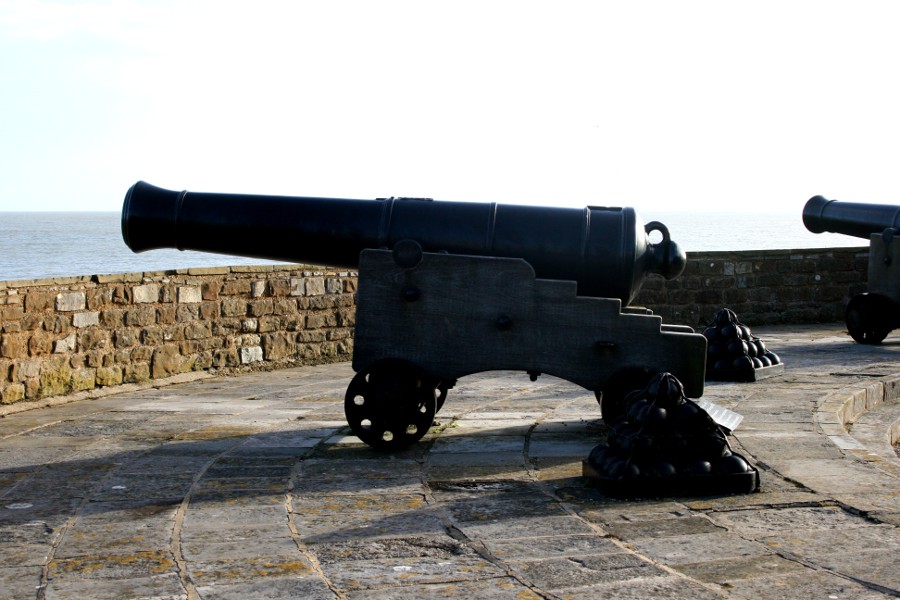
Cannon at Walmer Castle pointing out to sea

But the castle at Dover had been in existence well before either of these.  Its site, high on the cliffs overlooking the Channel, means that it has been a place of defensive significance throughout history.

Entrance to Dover Castle

It's spectacular enough when approaching from the landward side, the north-west.

Dover Castle from the sea

But it's when you are going out to sea and see it stretched along the top of the white cliffs that you realise just how significant the position is.  There are tunnels underneath which at one time housed 2000 men.  It remained important even until World War II, when the tunnels were used as air raid shelters and then a military command centre.  Many of the tunnels are now open to the public. If you enlarge the picture, you can see some of the windows and openings into the cliff face.

This has become rather long, sorry.  We've had a lot of foreign invasions!

If you'd like to join in the PhotoHunt, and find other other players, pay a visit to TNchick's site where you can find out more.
Enhanced by Zemanta

LinkWithin

Blog Widget by LinkWithin