Saturday, 31 March 2007

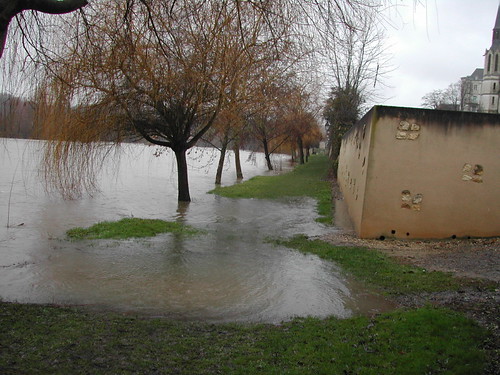
PhotoHunter: Water

February 2006

It started slowly:

water2

But then we had more water than we could deal with:
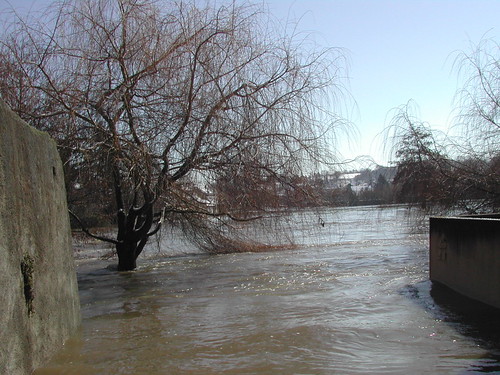
water1

Friday, 30 March 2007

"Too many women are dying giving life" in Malawi

I lived for a time in Malawi so the news caught my eye.

Malawi has one of the highest rates of maternal mortality in the world: 6,000 women a year die during pregnancy or childbirth. Approximately 30% of 15 to 19 year olds already have a child and many have unsafe abortions. The plan is to instigate a system of care, to be know as a Road Map, right through from contraception to pregnancy, childbirth and post-delivery. This initiative is backed by the UN and has been runas a pilot scheme in some areas.

Incidentally, from AllAfrica.com, one of the papers presented at a a workshop says that 80% of women needing treatment for unsafe abortions in Nigeria are adolescents.

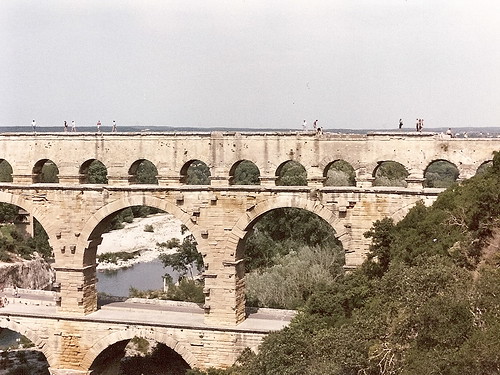
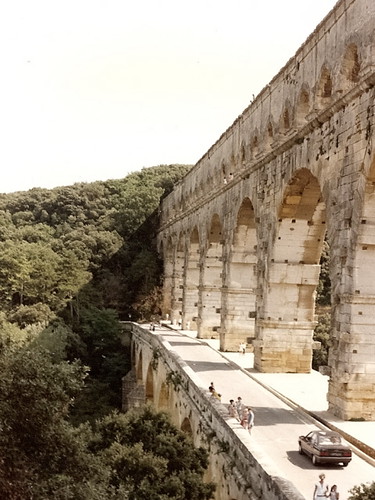
Pont du Gard circa 1987

I saw TorAa's post a few weeks ago about the Pont du Gard and it reminded me that we had some photos lurking around from about 20 years ago.

The quality isn't wonderful because I've had to scan them, but I think they show the changes that have been made since it became a World Heritage site. Interestingly, according to the Unesco site, it was adopted in 1985, and I am almost certain it was later than that when we were there.

This one clearly shows the people walking across the top with no safety measures at all.

pdg1-1987

The enlarged section below shows someone (on the extreme right) being helped to scramble up through one of the holes in the roof. Although it is wider than it perhaps looks, nothing in the world would persuade me out there.


The next one shows a car going over the bridge - I believe this too has been stopped.

pdg2-1987

As a footnote, I have been trying all morning to get the photos to show properly, only to realise after a considerable struggle, there seems to have been a problem with Flickr and not me!

Exclusive breastfeeding reduces HIV transmission

The subject of breastfeeding is complicated when the baby's mother is infected with HIV. Breastfeeding does carry an increased risk of HIV transmission but in Africa, with widespread poverty, the alternatives are not practical, so any way breastfeeding can be made safer is important.

The Lancet this week publishes the results of a study which demonstrates that babies who are exclusively breast-fed for six months are significantly less likely to acquire HIV from their mothers. If the babies receive other milk, the risk is doubled, and if they are given solids, the risk is increased eleven times.

There is an accessible report on the study in Science Daily, though I'm concerned to see a Google ad in the sidebar, promoting a tea as having 80% success rate for AIDS and HIV. Reuters Africa also have a report.

Thursday, 29 March 2007

Condom testers wanted

Condom manufacturers, Durex, are looking for 5,000 "on the job" condom testers in the UK, the only reward being a chance to win £500 . It is almost impossible to get to the site this evening.

When they advertised in France, they had 14,000 applicants in one day. It must be that advertisement again!

Mr Average

Following on from my earlier post on the subject of attractiveness, I saw today that university researchers have published an article which suggests that women will choose Mr Average rather than a high-flyer. The article itself is subscription only but the BBC has written it up.

The subject, 186 female students, were shown photographs of 60 young men which they were asked to rank in order of attractiveness. Those they thought would make the best partners were the ones they had assessed as most attractive.

The photographs were divided into three ranges of attractiveness: very good looking, average, and unattractive and six were chosen from each range. The women were shown these photographs again but this time they were given details about the man’s age, job, and what he would like in a partner. After the second ranking was done, the men chosen as potentially the best partners were the ones with middle-ranking jobs. There was however still a preference for the best looking ones.

Wednesday, 28 March 2007

Selecting attractiveness

While I’m feeling interested in the evolutionary benefit and genetics of sexual behaviour, another report worth mentioning has turned up, this time from the University of Newcastle, which explains why there is such an unexpected diversity of individual appearance in the population. Evolutionary theory would suggest that there would be strong positive selection for attractiveness, leading to far less diversity (and everyone boringly attractive?), and this fact is often used as evidence by creationists that Darwin’s theories of evolution are flawed.

The new theory is that some individuals will create greater genetic diversity because some spontaneous mutations will damage their DNA repair functions. This in turn will mean that in these individuals any other spontaneous mutations will not be repaired. When these mutations happen in the disease resisting parts of the gene, it gives the individual much greater resistance to infections. A computer model has shown that this extra diversity giving disease resistance (as well as diversity in appearance) would be of greater benefit than the reduction in diversity caused by sexual selection leading to more attractive people.

So next time you decide someone is unattractive, just think, they could be much more healthy than you are.

Faking it?

There have been two recent publications from the University Medical Center Groningen in the Netherlands, one looking at muscle contractions and the other blood flow in the brain during female orgasm. One of the findings was that either faking an orgasm, or failing to achieve orgasm produces different effects, and according to the first paper, it is the first time a physical measurement has been shown to have a strong correspondence to subjective reporting. I presume that would be helpful in treating disorders.

I vaguely wonder how typical a sample of the population they had there. It has to be a certain type to volunteer for a study like that.

A more readable report (and very interesting too) from 2005, published by the Wellcome Foundation, gives an account of twin studies (plus some others) which show that there is a strong genetic factor in ability to achieve orgasm. It also adds that the Dutch researchers had difficulty studying male orgasms because the imaging techniques they used required a response lasting two minutes.

Monday, 26 March 2007

Papillon update

I've translated Papillon's latest post here. If you want to start at the beginning of the posts in translation, it is here and if you would like to go to the original French, this is Papillon's blog.

Sunday, 25 March 2007

Population decline

According to the Japanese government and the Institute of Population and Social Security Research, the population of Japan is expected to decline by 20% by 2050, if present trends continue, and by that time about 30% would be over 65. This has been going on since the 1970s.

According to a BBC report: "Japanese women have cited inadequate child care, low part-time wages and long hours worked by their husbands as some of the reasons why they do not have any children, or only have one".

This has been taken further by an article in the Times about two weeks ago which says that the reason for the decline is that Japanese couples just don’t have sex. According to the Ministry of Health and Welfare, 39.7% of the population aged 16 to 49 (16 seems a bit low to me) haven’t had sex in the last month and the Family Planning Association says that if that is the case, they are unlikely to have sex for a year.

The reasons given are the pressures of work for both men and women, lack of privacy in small apartments, poor communication. It is a serious problem. While the birth rate declines, the population is living longer and more pensioners will have to be supported by the taxpayer.

The population replacement level is considered to be 2.1 children. In Europe it is

Ireland: 1.99
France: 1.90
Norway: 1.81
Sweden 1.75
UK: 1.74
Netherlands: 1.73
Germany: 1.37
Italy: 1.33
Spain: 1.32
Greece: 1.29

So there is a very similar problem in Europe though it hasn’t been suggested that it’s because of not having sex. Various governments have put measures into place to try to counteract the problem. In France there are increasing tax relief according to the number of children, generous child allowances, and reductions of all sorts if the family has three or more children; Germany is proposing generous child care allowances; and Russia too is introducing a programme to encourage couples to have more children.

The various ways the governments in Europe are addressing the problem can be seen here.

Of course it could be everyone is now using those French condoms. It could be a plot by France to take over the world.

British Summer Time

It’s official – the clocks went forward last night (but it's hard to tell by looking out of the window - cold and grey). Somehow I missed the announcements on the radio, television, so we’re a bit behind ourselves today as we try to catch up.

The clocks change throughout Europe on the same day, though this hasn’t always been the case. I can remember there being a three to four week lag between the UK and mainland Europe, causing great confusion when trying to contact people – were we on the same time, or two hours ahead, or behind?

One autumn, a good many years ago, we went on holiday and totally missed the clocks changing because we used to avoid all radio or television, and we had no mobile phones in those days. The time apparently changed half way through our two week holiday and we spent the whole of the second week being mystified by the ways in which the rural community in France paid no heed to opening hours or general timekeeping. It wasn’t until we arrived at the port an hour early that we realised.

And now someone is going to tell me that the clocks changed in North America, what, about three weeks ago? It's finally dawned on me. I have a vague recollection that my sister said they were changing earlier than usual, and, when I’ve been looking at the traffic on here, I have been thinking you are all going to bed very early ….

Friday, 23 March 2007

PhotoHunter: Empty

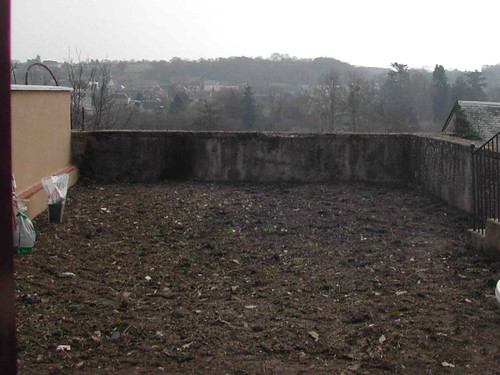
Emptygarden

It's really quite a small garden. Three years ago it was empty.

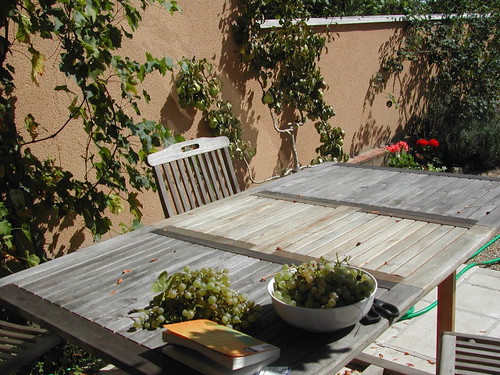
Last September, after some effort, the fruits of our labours were not only the grapes, but apples and pears too:

fruits

Elderly primigravida

An older woman pregnant for the first time - that’s how I was described when I first had a baby – and yet I was still (just) in my twenties. Nowadays that arbitrary age has risen to 35 and could perhaps even rise further, even if nothing changes. The number of births between the ages of 30 and 39 rose more than 100% between 1975 and 1990. With the advances of fertility treatment, women can now have babies after the menopause, causing considerable speculation and discussion.

There is an article in the New Scientist today detailing a newish technique to preserve women’s eggs by freezing to extend their fertility. There is a little doubt as to the safety of the technique but apparently there is no evidence that gives cause for concern. But the most interesting quote is from Gillian Lockwood:

The idea that healthy women should be able to control their own reproduction still frightens people," she says. "It was the same when the pill was introduced - people feared that the whole moral fibre of society would break down if women were freed from unwanted pregnancies.

Butterfly mind

I’ve heard people saying they have butterfly minds and I certainly have.

The chain of thoughts:

Figleaf of Real Adult Sex yesterday wrote a post about “senior” (awful word) sex which led me to remember when my younger son, aged about six, found me sunbathing topless in our back garden. He was clearly not happy about it and handed me whatever it was he wanted over his right shoulder so that he didn’t have to look. Such a compliment!

That led me on to a friend’s child of a similar age who went with his parents to the beach one summer’s day. There were people there sunbathing topless and he asked, in one of those loud penetrating whispers, “Why aren’t those ladies wearing their vests?”

And this in its turn brought me right back to my younger son and the funny things he used to say, most of which I have, sadly, forgotten. He was a very talkative boy. As soon as he discovered talking there was no stopping him. One episode I do remember was driving though a major traffic jam with just the two of us in the car. It was very slow going. He eventually said,

“Hmm, I think Daddy would say bloody.”

“I think you may be right” I said without batting an eyelid.

Another 10 minutes or so in the car getting nowhere.

A big sigh from the back seat. “I think Daddy would say hell as well by now.” I tried very, very hard not to laugh.

There was a similar incident when we were redecorating the house, and my husband had been hanging some wallpaper. Elder son aged three came rushing in to me. “Come and look, come and look”.

So we went to look and he proudly pointed to one strip of wallpaper. “Daddy says that one’s a …”

Sharp intake of breath from me.

“A pest.”

Phew. It could have been so much worse ….

Poaching

I looked up the definition of poaching, you'll see why in a minute, and found first of all:

"Poaching is viewed by many people as an acceptable crime." This is relevant but is it right?

Then:

To cook in a simmering liquid
To become muddy or broken up from being trampled. Used of land.
To sink into soft earth when walking.
To take or appropriate unfairly or illegally.
Sports. To play (a ball) out of turn or in another's territory.


I've never heard of definitions 2 or 3, they are completely new to me, but it is the next one that is exercising my mind at the moment.

I am being poached. The man who used to be my boss has been moved sideways by the newly appointed Chief Exec and, quite frankly, treated abominably. He wants to set up a new organisation and wants me to follow him.

I am feeling very preoccupied.

Wednesday, 21 March 2007

Call 3919

I discovered today that France has a new emergency number, 3919, which came into force on 14 March this year for victims of domestic violence. It's available throughout the country, and though not a 24 hour service, it operates most of the day. The people who answer the calls are all specialists of various sorts and can take calls not only in French but in Arabic, English and Spanish.

They are however assuming that all victims of domestic violence are women so the "listeners" are exclusively female. I can't help feeling they are missing a point here (according to the Home Office 1 in 6 men will be a victim at some point compared with 1 in 4 women) but, at the same time, I believe it to be better than anything available in the UK. I don't know if this sort of service exists elsewhere but if it does, I certainly haven't heard of it.

Tuesday, 20 March 2007

Man's inhumanity to man

Many and sharp the num'rous ills
Inwoven with our frame!
More pointed still we make ourselves
Regret, remorse, and shame!
And Man, whose heav'n-erected face
The smiles of love adorn, -
Man's inhumanity to man
Makes countless thousands mourn!

Robert Burns


On 25 March, we will be commemorating the bicentenary of the Act of Parliament which abolished the slave trade in the British Empire: an Act for the Abolition of the Slave Trade. Some details of the history can be found in the National Archives website, and more on the government site.

All this week BBC local television is broadcasting programmes showing the local connections with the slave trade - it has touched people all over the country. We are not so far from a large naval base which has a special exhibition "Chasing Freedom" to show the navy's role in combating the slave trade.

Is any of this enough to stop it happening again, albeit in a different form? Modern day slavery remains a huge problem. When will we ever learn?

Scenes of a Sexual Nature

I went into town intending to buy my mother a copy of The Queen on DVD as an extra gift for Mothering Sunday. As I was queuing to pay, reading everything readable in sight as I do, my eyes lighted upon a copy of Scenes of a Sexual Nature, also newly released on DVD. So I bought it.


I had heard about it some time ago from an aquaintance whose nephew was involved in the production.

For a spur of the moment buy, it was a great success. While it isn't quite in the same category as The Queen (and I don't think I'll be lending my copy to my mother) it is a very entertaining film. The BBC's review describes it as "a determinedly low-key comedy drama with no revelations to rock your world, but it's also an invigorating breath of fresh air". I would say it is rather better than that. I found it interesting and touching, and it made me laugh out loud. It was great to see that the couples weren't all young and beautiful.

Trailers and information on the cast etc. are here. Excellent cast; great fun; I thoroughly enjoyed it.

Monday, 19 March 2007

Papillon update

Two more posts over the weekend and today, starting here. I have included a long response to the last post.

Sunday, 18 March 2007

Mothering Sunday

Unlike Mother's Day in other countries, Mothering Sunday in the UK is a movable date – it is the fourth Sunday in Lent – but it has become synonymous with Mother’s Day in recent years.

It originated from the requirement for people to worship at their "mother church”, the church where they were baptised, at least once a year. This was naturally near their home and family and so it became associated with returning to see their mothers. The tradition, dating from the 16th century, grew for domestic servants and apprentices to be given time off work to do this. Flowers are the traditional gift because they could be gathered along the way home.

The day has in the past been known as Refreshment Sunday because the fasting during Lent could be relaxed; or Simnel Sunday after the traditional cake, very similar to Christmas cake. The names Rose Sunday or Laetare Sunday also refer to the same day. Rose Sunday is so called because it was the day popes used to bless the roses sent to Catholic sovereigns, and Laetare Sunday (Latin meaning rejoice) after the first word of the introit sung that day. A couple of years ago one of the local supermarkets gave a rose to every woman visiting that Sunday. I thought it was very pleasant but it must have cost a fortune because it was a once off, in the days before Sunday shopping became popular.

France celebrates la Fête des Mères on the last Sunday in May, but it is the second Sunday in May in most other countries. Looking at the different dates that it is celebrated around the world, it would be interesting to know why the differences arose. I do know that some celebrate on International Women’s Day, 8 March but there are a good many others.

I have done my duty and bought a gift for my mother, along with a posy of flowers. I didn’t find enough flowers in the garden and had to buy some but they are a proper posy, not a florist’s bunch.

My sons are in France normally and they often miss Mother’s Day completely or end up marking it twice. This year though, number 2 son is in England for the weekend so for the first time in ages I will see one of them on the day. How good is that!

Friday, 16 March 2007

PhotoHunter: Drink

This pump is in our garden. It still functions as a pump of sorts, with water falling into a small pond. We don't, but birds do, drink from it.

pump3

The interesting thing about it is that we found it inside the house, in the cellar.

pump1

This how we first saw it: it was once the original water source for the house.

If having a drink from a pump like that makes you think "ewww", spare a thought for many parts of the world where they would think it was the height of luxury.

Books for Boys

Earlier this year the Guardian book blog published a post "The wrong kind of reading lessons" which more or less says that the books being targeted at boys, while praiseworthy in their attempts to persuade boys to read, are reinforcing stereotypes: “a fast food menu of impoverished stereotypes …., based on rigid class systems and exclusion”. The article received a mixed reception.

This week Guardian Unlimited ran an article which reports that a government minister is advocating boys’ bookshelves in school libraries, again in an effort to encourage boys to read.

When they were young I did everything I possibly could to introduce my two sons to the pleasures of reading: library visits, story times, reading at bedtime. One of them turned out to be a reader, the other, well, perhaps he is a late developer.

Personally I don’t really think the content matters too much within certain limits. I was such an avid reader as a child that, living in Africa as we did, my parents couldn’t keep the supply of books going. That’s when I developed my liking for medical journals, specifically The Lancet. I happily read my way through the multiple Enid Blyton series and I really don’t think it did me any harm, for all their repetitiveness, limited vocabulary and dated attitudes. I remember one story which praised a “good” girl though I can’t remember why. I was not impressed so I clearly didn’t think I was likely to be included in that group. Strange the things which stick in your mind.

Where I do quibble about these “boys’ books” articles is at the division of reading matter into boys’ and girls’. As a girl I loved mysteries and adventures. Would they have been available to me if we had had a boys’ bookshelf at school? The books my younger son could be persuaded to read were usually about crafts. Would they have been on the girls’ shelf? Why compartmentalise reading like this, and worse still label it male and female? It could be alienating a sizable number of children who don’t feel their reading tastes fall into the “right” category.

Thursday, 15 March 2007

Papillon update

Papillon has posted again today, and again you can find the translation here.

Reading French

For the first time I have finished a book written in French, voluntarily at least. I have attempted several over the past few years but I haven’t got very far I’m afraid. This time, instead of trying to get to grips with “improving” literature, I took the advice of a French friend and chose a mystery/thriller so that the story would pull me along, and it did. I feel remarkably smug!

The book itself was Sans Feu ni Lieu by Fred Vargas who has written several books, some of them, though not this one, translated into English. I followed up immediately by reading another of her books in English, “The Three Evangelists”.

I’m not usually very keen on translations because I never feel they read well. A couple of years ago I was at a talk given by Ruth Rendell who recommended Henning Mankell as a good crime novelist. His books have been translated into English from Swedish. I don’t desperately like them because I am constantly aware of a Swedish lilt to the language, I find the names of people and places extraordinarily difficult to pronounce (I know it’s not reading aloud but I have to pronounce them in my mind) and the stories themselves I find bleak. My husband on the other hand, thoroughly enjoys them. He says Sweden *is* bleak and he doesn’t find the lilt or the names difficult, possibly because he used to travel there frequently.

Coming back to the Fred Vargas translation, I found it excellent. I was very much aware that the English didn’t read in the way it would if it were originally English but since it was set in Paris I found it lent to the atmosphere – pretty much why my husband likes the Mankell translations. Just today though, I had a notification from Amazon, recommending The Three Evangelists. That led me to read the reviews, and one of them really was very scathing about the translation – said it was no better than school level.

I know very little about the mechanics of translation. While I have been translating Papillon’s blog, I found myself wondering whether it is better to translate some phrases literally which may be understandable but sound odd in English, or to substitute another phrase altogether, one that is more normally used but conveys a similar meaning. In the end I did a mixture of both because I felt it lost too much of the French flavour if I used entirely English phrases, so perhaps that is what the translator was aiming for in The Three Evangelists. I’m even more smug now – I’ve finished one French book and now I like to think I’m a professional translator!

Wednesday, 14 March 2007

Brand new header

Lissa, of a Pity I'm an Aquarius, very kindly designed this new header for me. It's taken a lot more work than I had anticipated, so thank you very much indeed lissa!

PS I'm not quite sure why being an Aquarius should be a problem ...

Tuesday, 13 March 2007

Celebrate the difference

This is an idea copied from Charlotte’s Web, I have to admit, but it seems appropriate as I return to England and find things, well, different.


First of all the ways I don’t feel British:

I keep trying to shake hands with everyone I meet, if not kiss them. Nor do I stress about how many times to kiss – 2, 3 or 4?

I’m dismayed by infrequent refuse collections in the UK.

I don’t expect milk in my coffee.
We invariably say “bouchon” when we mean traffic jam. Other standards are déchetterie and mairie. Why we should have picked on those in particular I really can’t say.

We’re very surprised not to be offered bread with a meal.

We don’t tip unless service is exceptional and then only a little (15% included is already enough). We love the range of cheeses.


But I am not French because

I observe speed limits, red lights, and I don’t overtake on blind corners.

I don’t like andouillette. I have tried it and I will never, ever, do so again.

I do like mint sauce with roast lamb. I even grow mint in the garden, to the consternation of everyone.

I haven’t dyed my hair any of the varying shades of red favoured by “ladies of a certain age”.

I haven’t even attempted to lose weight by applying any of the creams so widely displayed in pharmacists’ windows.

I’m surprised, shocked even, when the doctor prescribes multiple and expensive medicines.

I don’t think French cooking is the best in the world.


When we used to visit France on holiday, many years ago, part of the enjoyment was looking at and buying the very different goods on sale in shops. Nowadays the range available in all countries has diversified so much that it is hard, if not impossible, to find anything unique. A shame I feel.

The very first time we lived in France, within my first few weeks, I was invited to lunch at the house of an English woman, married to a French man, who had lived there 15 years or so. Excellent I thought, I’ll see at first hand what French people eat at home. I arrived and was told we were having a special treat! How disappointed I was to find that they had been out especially to buy very British ingredients for a very British menu. It turned out to be pork pie with Branston pickle!

It wasn’t until I had been there some time that I realised the craving you get for some sort of reminder of “home”, even if it wasn’t something you would normally want. Something like the comfort of nursery food. I always used to make sure I had a supply of golden syrup and porridge oats, not, I have to say, normal everyday food for us, but I felt they needed to be on hand, just in case of emergencies.

Monday, 12 March 2007

India and HIV/Aids

It seems to me there is quite a lot of press and other coverage about the HIV/Aids situation in sub-Saharan Africa but not a very great deal about the situation in India.

An article in the BMJ by a second year medical student tells of his dismay when he heard, during a discussion about HIV/Aids, a professor say that there was no problem of homosexual transmission in India because there was no such thing as homosexuality. The responses to the article are also worth reading.

The writer also highlights the fact that sexuality in general is a taboo subject and that is the focus of a more recent article in the New Statesman, “Can a condom bar raise awareness about HIV in India?” by Preeti Jha.

When trying to find out more she attempted to speak to the organiser of the condom bar but he refused to discuss such a subject with a woman. She found similar attitudes everywhere so no surprise then that 30% of students in Chandigarh practise unsafe sex.

Apparently India now has the dubious honour of being the country with the highest number (5.7 million) of people living with HIV, according to a report from the UN, having recently overtaken South Africa. Without a focus on education, and from an early age, with media cover to reinforce the messages, it is hard to see how there will be any improvement.

Papillon update

Just before we left France Papillon posted again, and then again today. My translations of both can be found in the usual place in the 2006 archives.

Service will be resumed ...

We arrived safely last night after a long but uneventful journey.

Saturday, 10 March 2007

PhotoHunter: Architecture

A little early, unless you're on the other (eastwards) side of the world from me, but I'm expecting to be busy tomorrow. Well I'm supposed to be busy today but ...

la caze

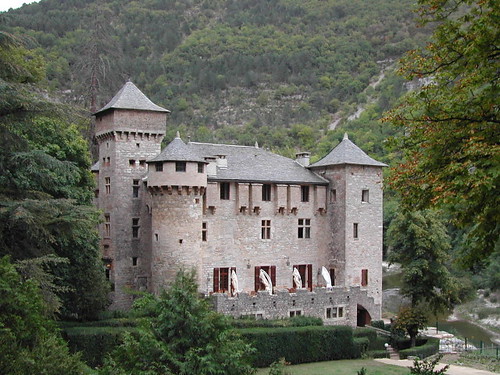
The 500 year old Château de la Caze in the Gorges du Tarn is one of our favourite stopping off places when going south to see our sons. It is the most wonderful, romantic hotel with a lovely restaurant. I am always convinced I will meet the Lady of Shalott, my Lady Greensleeves, or their French equivalent, round one of the corners.

Willows whiten, aspens quiver,
Little breezes dusk and shiver
Thro' the wave that runs for ever
By the island in the river
Flowing down to Camelot.
Four grey walls, and four grey towers,
Overlook a space of flowers,
And the silent isle imbowers
The Lady of Shalott.
These two following photos are views from the windows of our room the last time we were there.

caze4

caze6

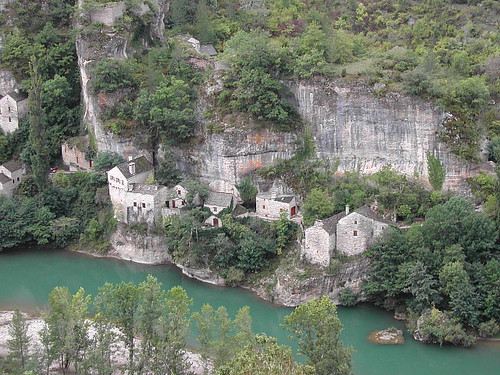
A little further down the river was an entirely different style of architecture - homes built directly into the rock.

gorges
This was taken from high above the gorge.

Friday, 9 March 2007

Back to Blighty

Things will have to be a little quiet for a day or two - we are travelling back to England and I am in the midst of my usual chaotic preparations.

A poem which I learnt as a child in Ireland has been flitting through my head. I learnt it so well that I can still recite it off by heart. I've always loved it, even when it was being drilled into me!

The Lake Isle of Inisfree - William Butler Yeats

I will arise and go now,
And go to Innisfree,
And a small cabin build there,
Of clay and wattles made;
Nine bean rows will I have there,
A hive for the honey bee,
And live alone in the bee-loud glade.

And I shall have some peace there,
For peace comes dropping slow,
Dropping from the veils of the morning
To where the cricket sings;
There midnight's all a glimmer,
And noon a purple glow,
And evening full of the linnet's wings.

I will arise and go now,
For always night and day
I hear lake water lapping
With low sounds by the shore;
While I stand on the roadway
Or on the pavements gray,
I hear it in the deep heart's core.

Thursday, 8 March 2007

Blogging against sexism

Blog Against Sexism Day

I work in IT. I’ve been in IT in some shape or form all my working life, a long time now. I started as a programmer for a large engineering firm in an industrial area and found myself almost alone in a man’s world.

I worked for seven years before stopping (had to stop in those days) to have my first child. By then I was far from the only woman though we were very much the tiny minority. However I remember thinking that progress was being made and that no doubt, things would even out. After all there is nothing about IT that need in any way be perceived as “unsuitable” for a woman. The usual excuse for many careers is that they are physically hard or that they are “dirty”. Debatable anyway, but IT just doesn't fit into those categories.

Indeed later on in my career, things did seem to even out. I had a good number of female colleagues and things seemed stable.

So what has happened?!!

I started working at my sons’ secondary school, helping out with computer studies lessons. Very few girls took it as an option and not one wanted to take it any further. Very few took maths. One mother came up to me and told me her son had said to her “Mrs {} knows an awful lot about computers considering she’s a housewife”. This was related to me with all seriousness, as a compliment.

What way are we educating our young people that these situations arise - that young women don’t feel a career in IT is attractive or suitable or relevant, or that young men can have these perceptions of a woman's place?

Of course now I'm getting the ageism. Powerful stuff when combined with sexism!

International Women's Day 2007


You can find out about International Womens' Day here. It dates from the early 1900s, and apparently is a national holiday in some countries.

Wednesday, 7 March 2007

Papillon's mother

This morning I translated a post from Papillon about her mother. It was such a sad post. She doesn't feel she can talk to her mother about anything intimate.

I struggle to talk to my mother too. She is now very elderly and frail, and I am her nearest relative, both in terms family and of distance.

She has always been very concerned with her position in life. I suspect marrying my father, a doctor, gave her the respectable position she craved after her own risqué-for-the-time upbringing. Nevertheless she was always very disparaging about my father's family. We were constantly being admonished about how we spoke, behaved. I can remember her apologising to one of her friends for the accent my sister and I had picked up in one of the places we lived.

That didn't make me feel good, but worse was to come on the day she said I could have plastic surgery if I didn't like how I looked. I hadn’t even been aware of the possibility of needing it. Then when she said “I really pity your husband” that I was truly wounded. Because I wouldn’t wear what she wanted me to wear. I was 12 years old. My confidence was undermined for ever. Although things have improved over the (many) years since, I will never be described as assured.

I have tried to understand her better. I tried to persuade her to record her memories but all we got were socially acceptable memories of her colonial days in Africa. Nothing intimate, nothing personal - only stories which were designed to impress. I had hoped for some sort of revelations about her hopes and fears, the things that had made her the way she is, rather like the ones in Amy Tan's The Bonesetter's Daughter.

No, I can't really talk to my mother. I do try. She has become less demanding recently so we are getting on a bit better. We aren't living in a novel after all, and nothing she did will match the enormity of what Papillon's mother did to her.

Tuesday, 6 March 2007

Sexism in advertising

I found a great French site, La Meute, which holds an annual prize for the most sexist and the least sexist advertising. The voting is closed for the 2007 prizes but had I realised earlier I could have voted on line.

My favourite out of the finalists for least sexist prize (Prix Femino) is the insurance company which ran a series with text such as:

~Sorry, man's superiority does exist. All you have to do is compare retirement~
~You struggle to be an independent woman. Only up to the age of 60?~
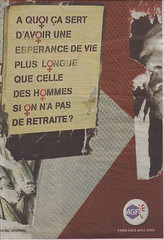
~What good is it to have a longer life expectancy than men if you don't have a retirement?~

The last has this illustration:

agf

It brings to attention the fact that millions of women reach retirement age without adequate pension provisions, largely because of inequalities of earnings throughout working life.

Another I like:

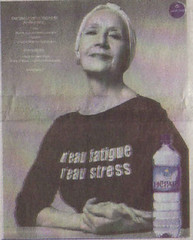
hepar

An advertisement for a mineral water, showing an older model with a t-shirt reading n'eau (no) fatigue n'eau stress. I like the play on words but particularly that the model is not young and yet is very attractive. And as La Meurte says: a miracle that a model over the age of 22 and a half can still work!

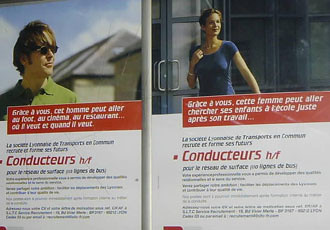
There aren't as many illustrated examples of the prize for the most sexist advertising (Prix Macho), but one of them is this one looking for bus drivers

image8

which says that (if you're a man) you will be able to work hours that allow you to go to football, the cinema, the restaurant, and whatever you like. If you're a woman on the other hand, it gives you the chance to pick up the children from school after work.

No comment.

There are apparently La Meute Suisse and La Meute Québecoise and I've just come across Gender Ads which is rather hard on the eye but apparently being revamped.

Sunday, 4 March 2007

Weeping willows

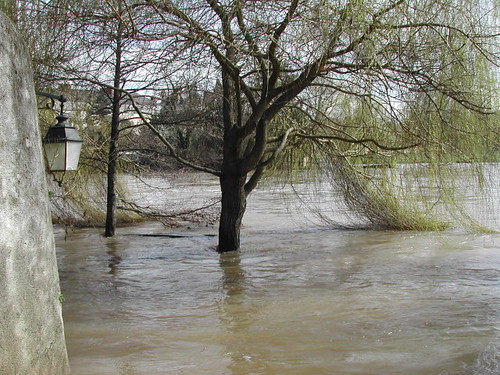
Remember this just a few days ago? We went away for a short break and this is what we found when we returned.

willow flooded

It is almost the same angle but I would have had to wade out to be in precisely the same spot. As it was, my toes were in the water. You can just about see the boat, now submerged. Our tranquil river has turned into a torrent, with more rain forecast.

Saturday, 3 March 2007

PhotoHunter: Salty

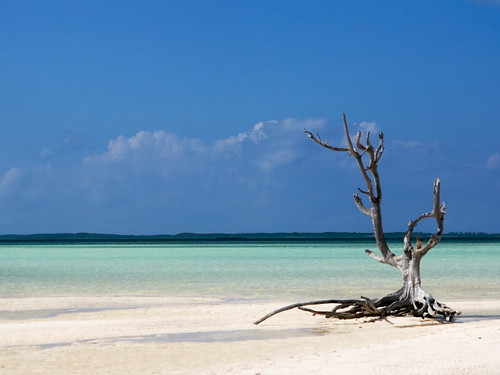
tree B


I must go down to the seas again,
for the call of the running tide
Is a wild call and a clear call
that may not be denied
John Masefield - Sea Fever


Water, water every where,
And all the boards did shrink;
Water, water every where,
Nor any drop to drink
Samuel Taylor Coleridge - The Rime of the Ancient Mariner

Friday, 2 March 2007

Papillon's blog

Papillon posted again on her blog, which I translated very rapidly last night before I disappear off for the weekend. The new ones start here but I have linked them together so that they follow on from each other.

There may well be another soon because her doctor's appointment is this morning - she will be well on her way if she hasn't already arrived. What is making it all the more poignant for me is that she is going to the hospital in a town where I lived for three years.

If you want to read all of Papillon's story of how she was circumcised as a child of four, and her subsequent decision to have the mutilation, as she called it, reversed, you should start with the introduction.

Thursday, 1 March 2007

World Book Day: Save Braille

On World Book Day it seems appropriate to make sure anyone who wants to read is provided with the means to do so.

Many blind people are being denied this essential skill because of lack of funding, resources, lack of knowledge of the Local Education Authority and lack of braille teachers. Braille needs to be promoted and is essential for blind people to enjoy the right to read!

I came across this piece on DoveGreyReader's blog:

"My name is Clare Gailans. I am totally blind and have used braille as my means of literacy since starting school at five, that's to say for over 40 years. I have always told people what a wonderful system braille is, and had imagined it would always be offered to those who need to use it to read. Technology makes it very much quicker to produce now, and the Disability Discrimination Act requires information to be produced in it if it is the most appropriate format for the recipient.

This is all very well for us adults, but it is becoming clear that shortages of qualified personnel, money, or perhaps just plain arrogance, are creating a situation in many mainstream schools where blind children are not taught braille, and those with useful sight are often denied it until their sight has further deteriorated. By this time many of them already hate reading, which is a huge extra strain on them throughout the school day - a stressful time for many children at the best of times.

Apart from the people close to me, books are my first love and I came to them through braille. Books can be listened to with enjoyment, but this is not literacy. I could not have enjoyed sharing my love of books with others through email, or made virtual friends with so many lovers of books such as Lynne, without being able to write, spell and punctuate. Listening to voices as a poor second to literacy would not have taught me these things.

Without first learning to read words I could not have mastered music through braille notation, which has been the key to my employment for the past 25 years, and my obtaining a degree in music from Cambridge before that. Braille has also been the difference for my husband and me, through such activities as music and chess, between being merely tolerated in the sighted community and being fully accepted, indeed sometimes looked up to, for our contributions.

It has helped me in a variety of voluntary activities, and to instill a love of reading in our two sighted children. I could not run our household efficiently without it, in every department from cooking to labelling the many reams of paper which have to be filed, and which without braille would all feel identical."

If you are a UK resident you can add your signature to the online petition.

Updated: I have just found a New Statesman article covering much the same topic.

LinkWithin

Blog Widget by LinkWithin